There have been a couple of instances recently that has seen sex raised as a tool wielded by bus companies to promote their wares. Not everyone is, understandably, in agreement with this; after all, sex and travelling by bus couldn't be further detached, though in the age in which we live, there's far less appetite to play things safe.
Bed bath, Sir?
Tividale-based Diamond Bus Company made the Daily Telegraph, no less, last month, when the image of an Ann Summers-clad saucy matron was placed on the rear of some of its buses that serve the Worcestershire Royal Hospital. Paired with the exclamation "Ooooh Matron" (that's missing a separating comma), Diamond Bus came in for swift chastisement by the Worcestershire Acute Hospitals NHS Trust, who initially asked for the image to be removed, claiming it degraded its nursing staff - many of which are male.
Have they missed the point? Was it too much? Do Diamond Bus' passengers care? Depending with whom you speak will offer both 'yes' and 'no' answers to all three!
A little nearer to LEYTR territory is Stagecoach in Peterborough, who introduced a fleet of Stagecoach-standard Trident 2s with ALX400 bodies in 2006. All carry clever rear-end adverts in the form of a diary of a supposed Peterborough resident, detailing their day/week in the city. There are insufficient depictions for a different one on the rear of each of the dozen-or-so 'deckers, so some are duplicated. Below is one that seems to have slipped under the duvet, er, net of the local media:
An undeniably attractive girl whose day in the city ends with her going back to her boyfriend's house. Nothing wrong with that, until you see how it's written: "Persuade Ben to take me to dinner and go out for a drink. Go home (his)." A friend shook his head in disbelief when he saw this and analogised: "Buy a Dayrider, get your leg over. Is this how desperate some operators are to sell their services now?"
Perhaps it's a little too subtle for the 'red tops' so Stagecoach has escaped the wrath of The Sun et al.
Back to Diamond Bus and their head of operations, Stephen Bryce, said the company had shown the advert to a group of nurses who found the rear-ended "very funny". He went onto say that it was his company's way of making bus services look less boring than travelling to the hospital by car.
LEYTR Comment: Can humour go too far? Has the humble bus into town become a mobile red light district? Does the average traveller want their local bus service to look less boring considering the vast majority of bus users simply are not interested in the industry provided they travel from A to B at the advertised time and for a reasonable fare? Diamond Bus didn't do too badly out of the Telegraph's piece - depending on your outlook it could have represented PR that money simply cannot buy. And while this, along with Stagecoach's clever rear-enders in Peterborough have been produced by a third party (we suspect both are the work of Mr Stenning), it is the commissioning companies who ultimately give each and every advert the green light - reaping the rewards for a successful and inspiring campaign, and having to release statements to the press when adverts aren't as well received.
That's right - the UK's first-ever rail fare costing over one thousand pounds. We have since tried looking for the same Newquay-Kyle of Lochalsh fare and it no longer exists. The fare now costs £921. So that's Arriva's CrossCountry TOC reducing the fare with the same level of secrecy to that which they introduced it.
This time we bring you news of bus-style conductors - making a resurgence no less - in Swansea, following First's introduction of its ftr bendy-buses there last September.
Even if your too young to remember conductors on board the buses, trams and trolleybuses in your local town or city, you're sure to have a good idea what one is. After all, they still exist in London, albeit on two heritage routes, and are effectively the bus equivalent to those that patrol the trains today.
They're 60 feet long and have been designed to replicate the look of a tram (Photo: Steve Montgomery)
First introduced its ftr (text-speak for 'future' apparently) brand in York on 8 May 2006, which saw a fleet of articulated Volvo B7s with Wrightbus StreetCar bodies link the city centre with the university, Acomb and Dringhouses. The idea was (and still is) straightforward enough - offer passengers a service that emulates that of a tram, but affords the operator the flexibility (and cost efficiencies) that comes with a manoeuvrable standard PCV. High-capacity, high-frequency, tram-like buses that operated along major population corridors.
A very rare shot of a ftr is seen here - in Chester.
Other ftr hot spots soon followed, with Leeds and Luton being two places that saw operation of this kind. Luton's linked the airport and was short-lived, now ceased, with the vehicles moving to South Wales for the newer Swansea ftr service. They weren't universally welcomed in South Wales though - not least due to £10mil of infrastructure alterations needed before the fleet could operate there.
Like York, Swansea's service started with tickets purchased at ticket machines at bus stops - the ftr driver (sorry, 'pilot') would simply drive. Problems soon occurred in York with new passengers simply at a loss as to what to do. Hurriedly, First introduced 'customer hosts' to the route at considerable cost and to this day they are still to be found on board. Swansea has also opted to introduced customer hosts, though First Cymru has cleverly placed a positive spin on developments therein by ensuring its hosts perform more than just a ticket issue/inspection service - they're to be trained as tourism guides, too.
The short-lived Luton-Luton Airport service aimed to transport large number of air travellers though wasn't as well patronised as First hoped. (Photo: Gerry Ward)
But isn't this what conductors traditionally always used to do? Back in the '70s it was commonplace to ask the conductor of your bus for directions or information about other bus routes. No third-party tourism company got involved. First, however, should be congratulated once again for putting its money where its mouth is and paying for the hosts to be visible on its ftr services. The company must surely top the list of bus operators employing the greatest number of customer hosts/conductors in the UK today (calling them 'conductors' could be counter-productive: the hosts might stake a claim for an increased rate of pay).
The original ftr service commenced - and continues to operate - in York. First was recently criticised for removing the ftrs from evening journeys and using one-man-operated standard buses instead, as a cost-saving measure
Reassurance to the public is something that wasn't mentioned in First Cymru's press release on their newly-qualified ftr tourist guide hosts, yet is clearly a massive bonus to passengers - especially the elderly and more vulnerable, who are sure to choose ftr over other operators' services simply because of the clear and visible presence of a member of staff - be he/she offering his/her opinion on the latest release at the cinema or not.
Hot-on-the-heels of the training undertaken by all new conductors to the railway industry, the online media have been very interested in an incident that took place at King's Cross train station last week. Commuters and leisure travellers were subjected to hours of delays following staff in the station's canteen allowing toast to burn, setting off the fire alarm and unwittingly instigating a major incident on not one but two occasions recently.
The Law of Sod dictates that if something is likely to go wrong, it will do so at the most inopportune moment, a belief nevermore reaffirmed at the timing of the two incidents - 0800 and 1800, both slap-bang in the middle of peak commuter times.
The first incident took place on 13 March and the second on 7 April. On both occasions, the entire mainline station was closed for 20 minutes, along with the King's Cross St. Pancras Underground station, affecting six Tube lines and as a precaution Eurostar services were also halted and passengers there evacuated.
The tragedy that took place at King's Cross back in the 1980s was one of the worst fires to happen at a mainline railway station, leaving 31 dead when a stray cigarette butt, discarded in an escalator shaft, caught fire at 1830 on 18 November 1987. The escalator shaft dated back to the 1930s and was partly made of wood which added to the speed at which the fire spread and the collapse of the escalator itself. Since then, King's Cross has unwittingly been synonymous with major tragedies on London's transport system; its Underground station being the last served by one of the Tube trains bombed on 7 July 2005 and the source of countless hoaxes.
It also didn't fair well for Boudica, whose body was recently claimed to be buried under one of the platforms, following a discovery of Roman artifacts there.
A total toast ban has been called for by London Travelwatch, if only to stop similar instances of needless disruption reoccurring, while Transport for London took a more sterile view, simply confirming that on two occasions now, burning toast in the station's mess room had sounded the fire alarms. The LEYTR Stig, who's very much in-the-know here, told us: "Steps have been taken to ensure this doesn't happen again..." and added, "those careless enough to leave toast unattended have been dealt with in accordance with their employer's disciplinary procedures". This would imply, would it not, that they could be agency workers.
Would a complete toast ban suffice? We think not. Only two months ago, the Caledonian Road station on the Piccadilly Line was forced to close after a member of staff there used the oven to stow his unwanted food, only for a subsequent meal-maker to turn the oven on to heat up and setting alight to four custard creams and a box of Rice Krispies!
Well that's it then. The German state's rail company will almost certainly control the second-largest bus company here in the UK, following Deutsche Bahn's (DB) official £1.5 billion offer for Sunderland-based Arriva. Is it such a bad thing? Does it show that privatisation the British way simply doesn't work?
Arriva's formation followed the re-naming of the Cowie Group in 1997, following its purchase of British Bus the year before; both operators effectively stopped bus drivers being paid by the state, purchasing a number of municipals - Derby, pictured here, is one example.
Arriva's purchase was something that came out of left field in terms of attack and time-scale. It was the result of their failed merger with the French state-owned SNCF coaching arm, Keolis, that placed Arriva's long-term credentials in doubt. Had they gone for an all-out purchase of Keolis, rather than a merger, things could have been very different now.
The merger showed Arriva's willingness to operate in-hand with another transport company. They clearly believed that a merger with Keolis would benefit their Europe-wide coach operations - something other members of the 'big five' do not have. It would also mean their emergence into the hitherto un-tapped French transport market. Did their courtship of the French ultimately backfire though, or has the offer by DBbeen accepted by shareholders as a positive step, when compared to continuing to trade as they had been? SNCF was also potentially in the frame for a counter bid, alongside DB, though wasn't prepared to offer such a high sum.
Who'd have thought, other than Hitler, that the German state would one day be running buses in Bridgenorth?
While it's true that employees of Arriva will effectively be paid by the German state, and as some have quipped, be German civil servants, the manner in which Arriva is likely to be operated isn't likely to be noticeably different from now. Anyone who perhaps believes Arriva will be operated in a manner befitting the municipals of the 1970s will be in for a big shock. The Germans will clearly want an impressive return for their £1.5bn outlay.
Turning matters on their head, if British Railways (BR) had still been in operation today, how would we - the tax payers who ultimately fund the company - react to its purchase of, say, Germany's second-largest bus company? The 'red tops' would almost certainly react in a manner sure to stir up criticism: "Spending our taxes on the Germans?!" One assumes there aren't similar news stories in Berlin right now.
Arriva's livery on the Class 57 isn't anything to write home about. Two of this type top 'n' tail the Welsh Assembly Express train, daily, operating between Holyhead-Cardiff
The other concern - less so for economists and more so for enthusiasts - is the potential for yet another corporate identity to be applied throughout the UK. And this time, a German one. Cue posthumous positive comments for the *British* Arriva livery and how the bland all-over 'Johnny Foreigner' red associated with DB would be another nail in the coffin of UK plc.
Should we be concerned about the potential for the livery change? DB operates Chiltern Railways using local branding, the same too for open-access Wrexham & Shropshire. It is also one of the partners in London Overground Rail Operations Limited. No red with simplistic 'DB' lettering here.
Freight sees a different outcome though, with DB reneging on its initial decision not to re-brand EWS upon purchase, with the first locos out-shopped in its red DB Schenker livery just over a year later. The Class 37s look very striking in their new red coat - dare we say a little more attractive then the dour all-over BR dark blue? Patriots amongst the rail fraternity were even more incensed here since the patriotic English, Welsh & Scottish Railway name was removed.
An outrage? DB's red-on-white logo on the side of trains built by BR is something many rail enthusiasts detest, especially when it replaced the patriotic (though Canadian-owned) English, Welsh & Scottish Railway name
Perhaps one of the immediate points to note is that the German state is currently in discussions with a view to selling its nationalised rail company, so while Arriva's source of finance is likely to be German-based in the long term, its employees' ability to boast they're now German civil servants is not.
It's a fascinating time. As LEYTR Chairman Paul Hill quipped in his 'Chairtorial' at the start of the latest LEYTR magazine, the English bus scene is anything but dull!
Arriva's Bus Operations in the UK
Arriva Buses Wales Arriva Cymru
Arriva London Arriva London North, Arriva London South, Leaside Travel
Arriva Midlands Arriva Derby, Arriva Fox County, Arriva Midlands North & Stevensons of Uttoxeter, City Linx
Arriva North East Arriva Teeside, Arriva Tees & District, Arriva Durham County
Arriva Northumbria
Arriva North West Arriva Liverpool, Arriva Manchester, Arriva Merseyside, Arriva North West
Arriva Scotland West
Arriva Shires & Essex Arriva East Herts & Essex, Arriva The Shires, MK Metro
Arriva Southern Counties Arriva Guildford & West Surrey, Arriva Kent & Sussex, Arriva Kent Thameside, Arriva Maidstone, Arriva Medway Towns, Arriva Southend, New Enterprise Coaches
Arriva Yorkshire
Tellings-Golden Miller Classic Coaches, Excel Passenger Logistics, Flight Delay Services, Link Line Coaches, Network Colchester, OFJ Connections
The Original Tour Arriva Wandsworth
Arriva has a 40% stake in Centrebus Holdings, operating K-Line and The Huddersfield Bus Company.
Arriva also has the sole operating right to the Green Line brand and has a separate Heritage Fleet, comsisting 9 Routemasters (RM5/6/901/1124/453/64/2217/355/60).
Not for a considerable period of time have I genuinely LOL-ed at my computer screen (er, LEYTR work terminal). Thanks to the irrepressible Railway Eye, the sound of laughter could be heard when I saw this:
Now I know what you're thinking. Not the funniest weed you've ever seen, but stay with me.....
This Yorkshire weed, to be found growing at Sheffield station last year, was deemed so substantial that it made it into 8th position in the Railway Eye's 2009 Railway Garden Competition. The judges were particularly impressed with its versatility - it made an impressive trip hazard, too.
"In snow thou comest. Thou shalt go with the resuming ground."
We Brits are all for the underdog, so I'm sure you'll be pleased to know that not only has Sheffield's award-winning weed survived the coldest winter for thirty years....
.... but has spawned literally thousands of offspring.....
Contributing writer 'CW' puts 2 + 2 together and makes.......
There's been something of a rumour or two doing the circuit of late, both concerning operators in my traditional East of England heartland.
With news that Stagecoach's Brian Souter is preparing his balance sheet for a large acquisition that may be 'just round the corner', speculation is mounting as to what business this could be. Clearly, such a giant purchase would probably involve one hell of a large business (and not necessarily a bus company! - c2c & NXEA are to be tendered soon), or could there be a host of smaller acquisitions timetabled to be snapped up at the same time?
Locally, councillors and other trusted folk in the know have suggested that Ben Colson's Norfolk Green could well be in line for a take-over. As with many smaller operators who run in a very rural area, the recession is taking its toll at the same time as local authorities are cutting back on the level of subsidy offered to bus companies.
In an interview with EYMS Chairman Peter Shipp (who's also a LEYTR member - Eds), routeone's Mel Holley detailed how, through cuts to reimbursement rates by two local authorities alone, EYMS will receive £1.5 million less this year despite journeys of this type continuing to rise.
EYMS own two subsidiaries - Whittle's Coaches and Finglands, the latter seen here, firmly anchored in urban bus operations within the metropolis of Manchester. Many operators would gladly purchase EYMS for this urban operation
Then of course there's EYMS itself, with Mr Shipp, the sole share holder, expected to retire soon and with this could signal the scrum for the largest independent bus company in the UK. Souter has often quipped about wanting to get his hands on EYMS - on one occasions bemoaning the fact that some bus company owners will still be running their businesses while strapped to a Bristol VR heading out into the North Sea.
The bubble has burst for Peterborough City Council, whose network of Localink bus services - the majority of which commenced with financial support from the government's Kickstart funding - ceased at the end of last year. PCC used the funding to provide new, meandering and circuitous routes of its own after Stagecoach simplified its network in the city to operate along main roads only, creating great swathes of bus-less population. These new services were never going to operate commercially after 3 years and so faced with finding funding from its own budget to retain them (which is already understood to be £1mil in-the-red), massive cuts are being made.
£36k for driving Optare Solos around empty? Sounds alright to me. That's what some PCC drivers have reputedly earned - more than a school teacher, or even that of the manager of a medium-sized bus company
I understand, though, that the Optare Solos used on the routes have been leased on a very long-term basis from Mistral (15 years or something equally eye-watering is a time frame I've heard quoted) and with drivers there now paid well in excess of £1-an-hour more than any other operator in the area, further problems are being faced about how expenditure can be curbed. Such is the manner in which the local authority (whose transport team employs a whopping 35 people - the axe is to fall here, too) has allowed its bus business to grow that it is now seen as being beyond its control and the entire operation is being passed onto the highest bidder later in the year. Whether a final-salary pension scheme and basic hourly rate of £9.92 (x1.5 Sat, x2 Sun) will be retained, remains to be seen.
Back with Souter and could rhetoric still exist between him and NX's West Midlands Travel business? The UK's largest bus company could well be a feather in the Stagecoach cap. Time, as ever will tell whether I've added 2+2 to make 4.
Finally, the long-awaited addition to First's Greyhound network was announced last week - Bournemouth. Actually, the destination showed up on the operator's website before any mention was made officially. All the press release did was effectively announce the start date.
Bournemouth is another South Coast destination chosen by Greyhound to link with Central London, with Portsmouth and Southampton being the first in its portfolio. The frequency of the new Bournemouth service will be a tentative two journeys per day and will commence from 1 May. Compare this with National Express, who operate 22 journeys, all calling at neighbouring Ringwood and many with stops at Hammersmith and/or Earl's Court in London, is it really worth Greyhound bothering?
Journey times appear similar, with Greyhound's 2:25 being five minutes longer than NX's shortest. Announcing the initial routes an 'unqualified success', Greyhound's MD Alex Warner said that this has prompted them to look at other towns and cities with which to link London. Really? The word on-the-street back in September was that more was to come, as soon as coaches became available (many released from NX contracts lost at tender). Mr Warner's position itself would surely be untenable for just two routes!
Clearly, Greyhound's criteria is similar to Megabus' when choosing a location - students and medium to short distance from London. Bournemouth has bucket-loads of students as well as a very high population - especially when the urban sprawl of neighbouring Poole is taken into account. NX's London coach all commence/end at Poole, offering a further advantage to the stalwart, who offer single fares from £2 each way. Greyhound is reportedly offering a quarter of its seats for £1 + 50p booking fee.
Yield management-style inter-city coach services that provide a limited frequency along an already well-served corridor have flourished, though - remember Stagecoach's litmus test? It ran Megabus services in competition with its own Oxford Tube expresses between London and Oxford (admittedly the London terminal was different), before announcing it a rip-roaring success and going onto instigate many of the Megabus routes we see operating today.
Greyhound's USP (unique selling point) is the luxury afforded throughout its fleet - additional leg room, wi-fi as standard and complimentary papers not being something normally associated with budget coach services. It also has its renowned image, too. First operates its Greyhound services without registering sections as local bus services and so receives no Bus Service Operator Grant (nor does it have to accept concessionaires wishing to use their free travel passes) and can chop and change its timetable as much as it likes as it does not need to give the Traffic Commissioner's office the required 56-day notice to commence or withdraw a service.
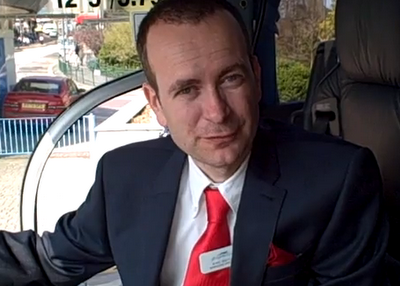
Greyhound's MD Alex Warner, who appears to be sporting a new-issue National Express tie!
We understand that a number of competing NX services betwixt London and the South Coast are also now operated in this manner, ensuring they remain as flexible to demand (and therefore potentially maximising profits) as possible. Using NX's Poole-Bournemouth-Ringwood-London service as an example, Poole-Ringwood is registered as a local bus service (17.6mi) and so is Hammersmith-London Victoria (4.7mi), totalling 22.3mi per single journey. Multiply this by 44 (total single journeys that comprise NX's 22 return trips) and Bus Service Operators Grant (fuel duty rebate) is payable on 981.2 miles *per day* or 355,194.4 miles per annum (based on 362 days' operation). The total amount is actually likely to be higher, as some of the anomalies to Weymouth and Swanage are registered as local bus services throughout their South Coast extensions beyond Poole, and services operate 364 days a year, though to a reduced frequency over Christmas and the New Year.
We calculate the fuel rebate on the 355,194.4 miles per annum to be in the region of £150-160k, or 103,333 Greyhound seats sold at £1.50. Clearly, it will take a lot from this two-journey, one-vehicle working to dent NX's profits on the Bournemouth-London flow. Despite this, I'm sure NX has a contingency of its own in place. Perhaps 'super fast' journeys that omit Ringwood, but since from here to Hammersmith their services operate direct anyway, how much would be saved?
I suspect NX's greatest concern is where next for Greyhound. First has a large operating base in Avon and the 040 (Bath-London) is one of NX's most profitable and frequent services - something First knows all-too-well, since they once operated the lion's share of services on this very route. I would be truly staggered if this wasn't somewhere near the top of their wish list. Perhaps the only thing stopping First is that they currently operate the Great Western rail franchise, also linking London and Bath. Some would argue they'd shy away from introducing a competing coach service, others would say that instigating Greyhound here would effectively see them corner the market.
Delayed by three years, over-budget and an unwanted replacement for what the majority of residents were content using, Derby's new £100 million bus and coach station opened on Sunday 24 March 2010. The new facility that has been built on the site of the former Art Deco structure dating back to 1933, sees a massive transformation for bus and coach users there.
Beleaguered is possibly the best noun to describe Derby City Council's fortunes from the day a decision was taken to foreclose the former station. There were numerous protests against locally-employed Charles Aslin's design being flattened by bulldozers, primarily from bus passengers who believed the station coped well with the level of vehicles that used it and formed the 'if it aint broke don't fix it' opinion.
The finished product is very colourful, though this is in no way down to the structure!
Demolition took place in July 2006 - delayed - following the station's closure on 22 October 2005. Protesters broke through the flimsy perimeter fence and camped out on one section of roofing. During the first part of 2006, they even managed to hoist a caravan onto one of the building's roof. No sooner had this obstacle been overcome when just three months after the station's closure, the main contractor for the scheme went bankrupt and with the City Council not securing any form of bond, there was a time that genuinely saw the entire scheme in limbo.
The new Westfield Centre replaced that of the Eagle at the same time as the bus station's opening. Linking the car park on the Cock Pit to the main shopping centre is a substantial walkway, under which pedestrian access to the bus station can be made
City centre congestion increased with all bus services calling at on-street stops and the requirement to allocate and police lay-over areas was also causing problems for many operators. A new developer was sought and work resumed - on paper - by April 2006, though not a spade had been lifted six months after this.
It was all a far cry from the 1930s when Charles Aslin designed the new station and its completion heralded the first bus station of its kind to contain double platforms and overhead canopies. Even The Beatles were rumoured to have dined in the upper-deck café during the Swinging Sixties. However, not everyone enjoyed the surroundings of a 1930s Art Deco facility and the local council submitted plans as early as 1977 were drawn up, with the station's demolition in mind. While the bus station's very own Action Group merely prolonged the facility's closure, they did ensure this was delayed for another 28 years!
The 5 coach bays are outside and are skewed at 45 degrees from the 24 main bus bays
They also ensured demolition was delayed by a further year following the caravan-on-the-roof incident. Was it time for a change? Residents thought not. Councils don't generally like paying for things on this scale that are un-needed, so by comprising the bus station's re-development with another in the city centre - Riverlights (with the principle contractor now in the black), justification can seem far stronger.
The old bus station did conform well to housing a great number of vehicles in a relatively small space. It also had four entrances and exits, compared to the new structure's two. Facilities were thin-on-the-ground and not in a particularly good state of repair, but then who opts to dine out within the confines of a city centre bus station? The architecture was incredibly pleasing to the eye and one of the last examples of its type in the UK. That said, I was very much taken aback with the new bus station when I saw it for the first time on Easter Monday.
Trent Barton's oldest bus service enters the UK's newest bus station
The number of departure bays remains constant, though there's a 100% increase in the need for reversing. Drivers of all companies received training in how to do this as safely as possible. Upon departure time, all vehicles should reverse in a straight line until clear of the vehicle to their right, then turn right and head for the lane designated by two double-white lines, in order to exit. All vehicles travelling forwards should give way to vehicles reversing.
The facility now boasts a very modern under-cover waiting area, with the excellent publicity you'd expect from Derby City (& County) Council, along with supplemented information provided by the local bus operators. A new travel office is situated in the centre and manned by City Council employees, ensuring impartial advise is given. Toilets are a marked improvement though now cost 20p to use. Staff facilities are behind closed doors and on level 1, with Trent Barton and Arriva drivers having separate canteens. Only the five coach bays have an outdoor waiting area, though substantial canopies are also present.
The 'Arriva Huddle' is evident here, with the operator taking up the central departure bays
Numerous departure screens are situated. A new problem exists now since the screens effectively show timetabled - not real-time - departure information. The newly-appointed security personnel are inundated with queries from concerned passengers who see their service had gone from the screen but hasn't yet turned up. By no means is this phenomenon unique to Derby, but one that didn't exist before technology got involved.
The City Council produced a Bus Station Blog from the start of 2009 when building work really got into full swing; their official web page details very little indeed - and no mention of the final cost of the scheme. Work continues on the main building, which will eventually house shops and restaurants.
As long as two years ago, operators and the City Council were vying for the best bays, and with a 60p-per-departure fee being charged, it's one of the UK's more expensive bus stations. A number of operators' services that hitherto used the bus station, no longer do so and pick-up on the streets of the city centre instead; in some cases this is down to the very high departure charge. Generally, though, the first bays are allocated to Trent Barton, Felix, Notts & Derby, Littles, Doyles and Kinch Bus services, then the low-teens are allocated to all Arriva services, with the high-teens and twenties allocated to Trent Barton and coach operators. Bay 1 is not used as a standard 40-ft bus reversing from here would do so into the pedestrian crossing and the main road (Moreledge).
The bus station has certainly left a lasting impression with me. It's a straightforward line of 24 departure bays, with the five coach bays continuing in a straight line but skewed by about 45 degrees. The backdrop is what makes the development look particularly impressive - very different to anything Mr Aslin would have designed back in the 1930s, I think you'll agree!
ReadPart 1, Becoming a Conductor: The Applicationhere.
Part 2
We were all getting along very well and arranged to meet next morning for breakfast in hotel restaurant prior to starting the Conductor course back at our TOC headquarters.
Meeting for our meals became a daily occurrence for the next 3 weeks (Monday to Friday) in Manchester and we all got along very well. I had a new nickname too – Frank as in Spencer. The guys from the North West all agreed this was very apt after hearing my stories of tales and tribulations!
By the second week the friendly hotel staff were warming to us and our friendly banter! The hotel meals were excellent - you name it, we had it for breakfast each morning. The a la carte evening meals were even better! All paid for by my new employer.
The first day with our trainer went well – he has 30+ years in the rail industry and could out-talk me with his stories of life on trains! Nice bloke!
We were now bumping into various other members of my TOC's staff, especially as the training room was on same floor as the staff mess room. I say 'mess room' lightly due to the fact they have leather sofas, digital TV and allowed us to contribute just £1 each per week to join there unlimited Tea/Coffee club – oh and Rail Gourmet food and drink provided (trainees only) for lunches - excellent!
Everyone we meet seem very pleasant so far! Professional but pleasant.
We were soon taking lots of notes for the training from our teacher's thorough presentations. It was also soon apparent the rail industry has a lot of jargon used on a day-to-day basis, of which I was simply unaware. A fair amount of slang is also used in relation to the day-to-day terminology. It was like learning two new languages!
We usually started training at 0900 and finished at 1600, so I made a point of revising and re-writing my notes taken that day once back at the hotel. Some great architecture and places of interest, old & new combining effortlessly. Interesting museums such as MOSI, which is located on the historic site of the world’s oldest surviving passenger railway station. Housed in five listed buildings, MOSI’s amazing galleries and outstanding collections tell the story of Manchester’s scientific and industrial past, present and future.
After the first few days learning about housekeeping, depot notices, weekly & periodic notices, sectional appendix and other things in general, we were now getting deeper into it. We were working through the Rule Book now, which is written to cover every employee’s aspect of working on the railway. As Conductors, we have to have full knowledge of signals so that took a while to cover thoroughly. From which signal box controls a certain signal to signal types, semaphore, colour light aspect, meanings, etc. Then there is the different terms given to sections of lines, station limits, track circuit block, absolute block, single line, token etc etc. From an outsiders point of view a lot to understand at first!
We went onto learn about the specifics of lines and the infrastructure for our PTS (Personal Track Safety) so the '4 foot' is the area between the running line; '6 foot' area between Up/Down tracks; and '10 foot' area between 3 or more running lines. The meaning of Ups & Downs for the lines is usually dictated by the principal station's location on that line [there are hundreds of exceptions to this, Eds]. 'Cess' been the nearside of a line and the safest place to be out of the 3 above! AC & DC electrification lines and equipment were also covered.
Train safety is obviously paramount so we were taught what procedures to perform to protect the track in various circumstances. From contacting signallers to how to evacuate a train. A day was spent at one of my TOC's depots for this and to use a simulator for one of the train types we'd be conducting. I managed to drive it from my soon-to-be new base to the next station without crashing!
It’s very much a team effort as if things do go wrong it is essential that Conductors, Drivers, Signallers, Train crew, Control Staff, Retail Staff fully understand what is happening and confirm this understanding.
An afternoon was spent in the signal box at Manchester Piccadilly - effectively a large window-less room on the 7th floor of Piccadilly Towers. A whole wall was lit up with a computerised illuminated map (a.k.a. the London Underground) of Greater Manchester. Every train (defined by its headcode) and signal is able to be seen at a glance. It's split into 8 segments - west to east - each given to a signaller sat at his control desk in front of said wall.
We had a day with a semi-retired couple, for the purpose of deafness and disability training. They are both deaf themselves but were amazingly good at teaching us the basics of sign language. The husband was certainly a comedian and didn’t allow his disability to cause him a problem whatsoever.
Another day was assigned to conflict training whereby actors are used to create problem situations in stations and on trains. The actors were extremely good and realistic in the language and actions used. By working through the scenes step by step as a class we learnt how to solve both their problems and ours! Obviously every case is different so we shall see what happens in the future though!
During the 2nd and 4th weeks we had written assessment questions to answer from what we had been taught based on the Rule Book and training to date.
A separate assessment test was undertaken to gain our PTS which allows us authority to go on or near the line.
The 5th week was spent in Huddersfield, commuting from Manchester, dedicated to the retail and ticketing procedures. The first three days went through paperwork then 2 days with the Avantix ticket machine. This week was frustrating as three of us had to share 1 machine which didn’t aid the learning! As part of the retail training we also spent one morning with qualified revenue protection staff. They had there Avantix ticket machines, chip & pin wireless bluetooth device, cash floats and table as we set up stall at a small suburb station west of Manchester to form a human ticket barrier... Great idea and an effective way of catching the fare dodgers! In just 2 hours we took over £500 in revenue that would have otherwise just walked out of the door. Various types of passengers were caught out, young and old who had overridden to our station, not bothered to buy a ticket or attempted to use concession passes before 0930.
Part of the 6th week was taken at Manchester undergoing the traction-type training that I'd be working with. We then received three days working trains by simply operating the doors under full guidance of the conductor. Everything we are taught has to be confirmed in written knowledge tests. This applies to Signals, Routes, Traction Types/Features, PTS & Rules & Procedures!
A lot to take in during a short period of time but once actually on the trains it starts to make more sense! Obviously it helps seeing what has been talked about for the past 6 weeks!
The 7th week saw the start of route learning from my new depot. I initially worked one of the shorter journeys, around 50 minutes in length each way. I also had a day put aside for a safety briefing.
Week 8 was dedicated to more route learning, this time the lengthier route I'd be working - including diversionary routes for certain journeys.
Week 9 saw me undergo my written Route Assessment Knowledge. I was able to refer to my notes and my personal ‘Route Card’ invention for prompting if required. Managed without so must have revised well! I also completed the traction-type training on the two traction types I'll be conduction aboard.
Weeks 10 & 11 saw me start out with my ‘Minder’ on his shifts. Another nice bloke who likes to see the job get done! Speaks his mind if need be and creates no fuss! Typically most of the time spent with him could have been busier in order to learn more. It was now very much a case of fast learning & quick decisions in real life working trains. In specific ways you learn more from minder than anything else. I had to think on my feet now especially when my 'minder' said he would follow me down the train then when I looked around to find him he had disappeared! Strangely the opposite happened when I was not expecting him to be around – there he was very astute & eagle eyed!
During Week 11, I completed the final traction-type assessment required of me.
Week 12 was assigned to further Rules/Regs & PTS revision and assessments. This was the 'biggy' - I needed to 'pass out' before being let out on a train on my own. Thankfully, this occurred, with my depot manager informing me of the good news. I then had three spare days, so spent the time volunteering to work a colleague's train, enabling him to put his feet up in the back cab.
Week 13 commenced 5 April 2010 and saw me on my own. It was Bank Holiday Monday and I'm working a normally hectic journey full of commuters, though I've been afforded a break since none were present. The amount I took on the journey was around twenty-times less that which I'd normally be expected to pay in. This eased me in nicely.
Other aspects of my training and required knowledge includes the phonetic alphabet, it being the accepted method of communication for the rail industry so this had to be learnt: alpha, bravo, charlie, etc.
Bell buzzer codes are also used on my trains as a means of the conductor communicating with the driver. They are:
1 stop 2 ready to start 3 set back 4 slow down 6 draw forward 9 police assistance required 2-2 do not open doors (driver to conductor) 3-2-1 testing doors 3-3 driver or conductor requires contact by phone
I am now fully averse with hand signals for day & night, railway telephones and how to recognize them by signs, all forms of railway signage, specific walking routes at our different locations, drug & alcohol policy, working time restrictions (12 hours rest between shifts; max 72 hours work each week; max 12 hours work each day) so shifts rostered between 5-11 hours and no more than 13 consecutive days worked. I carry essential equipment while on duty: PTS card; SCWID (safety critical) card; transec ID card; hand lamp; whistle; watch; safety shoes or boots; hi-vis vest; red & green flags; carriage keys and up-to-date notices, both weekly & periodical.
Inspired by the account of one of your readers learning to drive a train, I have composed what I hope will be an informative account of learning to be a conductor.
The whole process began for me from the comfort of my home, when I visited the website of the company for whom I'd eventually work. They're one of the 'big five' and have a corporate site devoted to offering jobs from all aspects of their business: buses, coaches and trains. The whole application process was able to be completed online and was fairly straightforward.
The online application was produced by a third-party company who specialise in recruitment and numerous well-known transport sector corporations draw on their considerable expertise. Accordingly, the questions asked are, in some cases, obvious, though for such a career change, candidates would do well to consider offering as fuller responses as possible. A number of questions were added at my train operating company's (TOC's) request, enabling them to sift through the applications with relative ease. Over 300 people applied, I was later told, so clearly the most important aspect of the entire application process can be done from the warmth of your home - completing the online form. It needs to stand out from the crowd.
The application closing date for me was 17 September 2009, thereafter the TOC's human resources department could consider the best applicants from the answers. Little did I know it at the time, but I was one of less than a dozen who were invited for an interview on 21 October 2009. Applicants need to be aware of the requirement to travel to possibly two locations over the following months, as part of the application process, without remuneration. Of course, for the successful candidate, this is clearly a price worth paying.
At the interview I was informed I was one of 7 people shortlisted from 320 applications. If I was successful at interview, which was to be scored on a points system (each interviewee was given the same exact questions to answer), I would then be invited to sit assessment tests. The interview lasted one hour and I felt the process went well; the sixty-minute period seemed to fly by. On the interview panel were two managers, both very amiable. As with any interview, most of us feel that we could have perhaps answered some of the questions differently - perhaps better. My moment for this came as I was travelling home on the train.
I subsequently received an email from HR inviting me to sit Assessment Tests on 17 November 2009, in a different locality. Sample test questions were posted to me by HR in order to revise and gain some insight knowledge of the tests. Again, no mention was made of travel costs so I funded this myself.
At the Assessment I was informed of the day’s schedule and it was also pointed out that if I failed to reach the benchmark for each written test then I would not be able to start the following test and would not be required to stay any longer, each test being marked immediately after completion. I progressed through the timed tests ensuring I made steady pace and no mistakes. Each test was timed by stopwatch. I didn’t actually complete all the questions for each test but I think they are specifically designed that way to enable judgement of pace AND accuracy.
After the final test I was given some useful feedback and advised of my scores and results. I had passed! I must say, as each test was attempted they were becoming more difficult and time consuming! My understanding is that of the 7 interviewed the month before, less than half were put forward for the Assessment Tests.
I heard nothing more until a request to go for a Safety Critical Medical examination at Bupa in Leeds on 22 December 2009. My TOC provided me with a travel permit on this occasion, and while I'd not been officially offered the position, felt positive about my chances, it has to be said. The medical was very thorough as expected with height, weight, body mass, eye test, hearing test, urine sample and previous medical history disclosed.
I was eventually offered the position by telephone call from my new boss on 30 December 2009 and confirmed in writing from HR on 4 January 2010. I commenced employment/training 11 January 2011. The entire process had taken one week short of 4 months, though as you can imagine, it was a wait I was ultimately happy to endure.
Up until now, my day job had been as a bus driver for Stagecoach, for whom I'd worked, clocking up thirteen years' experience as one of their better bus drivers. I was now looking forward - with great excitement - to starting a new career as a conductor. Had I really beaten off 320 other applicants? It seemed so unreal, but plainly true.
Following the verbal acceptance of the conductor position with my new TOC, my boss had informed me of a training course I'd need to attend on 11 January at Manchester. And so it was that on a freezing cold January morning I found myself stood on the platform of what I was soon to call 'home', awaiting the 0526 train to Manchester. I'll openly admit that emotions were running high over the new, unknown challenges ahead while stood with a suitcase in my hand, and I couldn't help thinking of the following U2 song:
Onwards and upwards it most definitely was. I was naturally saddened to be saying goodbye to some colleagues, passengers and friends I'd made at Stagecoach - I've not doubt I'll be keeping in contact - but life goes on and I was very much looking forward to what lay round the corner. The course would last for some weeks, with weekends spent at home with my family.
I feel I ought to make reference at this point to the fact that prior to being offered the job, I'd never worked in the rail industry, nor had I taken an active interest in it. I enjoy travelling by train and had made numerous trips each year on the trains I'd soon be conducting. My choice to apply to be a conductor was made to better myself. While I enjoyed working in the bus industry, I didn't see myself as a 'lifer' there, I needed a new challenge! Consequently, my knowledge of the railway industry and the procedures therein were not at the level of many who applied for my job - a number being those who push the refreshment trolleys through the trains. Clearly, my new boss had considered this and still wanted to employ me.
In Manchester, I headed to my TOC's headquarters for the induction day. There were 5 trainee conductors and 6 revenue protection staff all participating together. Our friendly teacher took us through the induction process - he was clearly good at his job and got us all acquainted. We soon all new each other by name and were then required to introduce ourselves to each other, mentioning our backgrounds and past-employments. It soon became apparent I was the only outsider as all the other people were internal transfers. This just added to the apprehension I was feeling.
Then it was awards time! We were all given a smart new watch and name badge to wear and a quality exercise book for noting contact names, numbers, itineraries, schedules, notes, etc… I’m sure you had to do 25 years at Stagecoach before getting a watch!
By mid afternoon we all called it a day and 4 of the 5 conductors made our way to a nearby hotel in Manchester to check-in. The fifth conductor had chosen to commute daily from Leeds, so that left me and three other guys all from the North West. We all agreed to have our first evening meal together in the hotel.
Part 2 - Becoming a Conductor: The Training, will be posted tomorrow.
One of the first gags I got as a child was of a pencil drawing of a zoo keeper pointing at an elephant that was stood over a huge pile of dung, with the caption stating: I said SIT!
Since then, I've always loved this kind of subtle - sometimes way too literal - humour, none moreso than that displayed by a First Capital Connect driver recently at King's Cross station.
Rumour has it drivers are now told to draw up as close as possible to the buffer stop at the end of the plaform, and clearly this driver has obliged. And why does the red stop sign at the top of the flimsy red pole need to even be there? What good would this do if presented with a runaway train?
You may recall last year that Manchester's population effectively ended the possibility of the expansion of congestion charging in our city centres for at least a generation, after residents unanimously voted 'no' to this, despite the unrivalled package of improvements this would create for public transport in the region. After dabbing its bloody nose, Greater Manchester Integrated Transport Authority has been looking at other ways the revenue, needed for these schemes, can be raised.
Despite the no-vote, Metrolink's got its extension and Network Rail is in consultation with the local authorities about creating a major railway hub in Manchester, with proposals for a new spur north of Piccadilly to ease cross-city train services. Now, the Department for Transport (DfT) has announced it is to use Manchester as a test bed for national bus policy, part-funding a study into ways in which current methodologies in delivering bus services can be honed to produce a better outcome.
You might want to roll your eyes now - albeit briefly - when the word 'efficiencies' was deputised for a whole sentence of consultant-speak by GMPTE's chief executive David Leather: "The work will address the extent to which local and national resources are being deployed to sustain bus transport and usage and what outcomes are delivered".. and.. "whether there are greater efficiencies to be secured in the delivery of bus services… through different delivery outcomes”.
Doubters will be persuaded to keep an open mind as the scheme will run alongside one being undertaken by the local authority and the Highways Agency, that will look at alterations to the road network that could help 'facilitate' these new 'delivery outcomes' for the bus network in the city and its environs. No one in the bus industry will turn their noses up at additional bus priority measures. And despite the roundabout manner in which this scheme has been announced, anything that furthers the cause of the bus industry is welcome news indeed.
A new traffic control centre will be established, whose likely role will be controlling the road network, using Transport for London's model, and equipped with an extensive toolkit comprising operational responsibility for traffic signals, speed cameras, CCTV systems, variable message signs and car park signs on all roads.
Reforms to the governance of the area will be needed and the proposed solution is a Combined Authority, made up of the 10 district councils. This will effectively be known as Transport for Greater Manchester. Doubters claim that despite the will of residents, the DfT and local councils are trying to force Manchester into a scheme it voted against, albeit without the imposition of congestion charging. But is that a bad thing? It was widely regarded as failing at the ballot box over the thorny issue of charging to enter the city centre; now, many of the benefits are attempting to be realised without the requirement to charge.
Yesterday saw the annual Cobham 2010 Running Day, with vehicles displayed at the Wisley Airfield and a shuttle service ferrying visitors between here and the Cobham Transport Museum. Last year, to celebrate 30 years attending bus and coach rallies, LEYTR operator Delaine Buses invited m'colleague and I along and we produced an article on the subject for the LEYTR Magazine. This year we went solo and thought we'd show a selection of photos from yesterday:
Travel de Courcey's Scania/Optare Olympus bathes in afternoon sunshine
Outside the museum buses can be seen loading passengers - an East London Scania Omnicity behind an RM
The second-oldest bus company in the UK is Delaine Buses of Bourne, who brought a recently-acquired Volvo B7TL (new to Whitelaw, Stonehouse)
Outside the museum is one of London's first Dennis Tridents - S801 BWC, new to Stagecoach, now preserved by East London
First in Eastleigh operate a fleet of ADL Dart/Enviro200s on Service 18. Eastleigh is of course a Mecca for rail enthusiasts
Guide Friday tours often use ageing vehicles, none more so than that used in Brighton - this 1966 Leyland Atlantean, new to Portsmouth
Greenline vehicles were in abundance, celebrating the company's 80th birthday. Seen here is a regular performer on their Central London-Luton Airport service, a tri-axle Van Hool T917
A little older is this 1953 Guy/ECW, seen at the museum
Mercedes-Benz Citaros are few and far between in Greenline colours - seen here is one allocated to the Hayes-Heathrow service
From one of the newest to one of the oldest - London General-liveried Dennis 4-ton with Dodson body, built in 1925. While I was stood here, the driver attempted to start it using the handle at the front, but to no avail
Midland Classic has recently acquired a Scania/Wrightbus, which looks very smart in the company's colours
Just under a dozen Greenline vehicles were parked outside the rear of the museum, providing a unique shot, especially since by this time next year the museum will have moved to new premises
The South Coast's 'smooth operator' brought a couple of vehicles; seen here is one of Velvet's Northern Counties-bodied Volvo Olympians
Routemasters continue to fascinate me (despite not being a Londoner). They were in abundance here
The latest 'Gold' brand Stagecoach has applied is to a selection of rural services north of Oxford. Note the addition of a cream swirl separating the two main colours. Its designer, Mr Stenning, was taking a photo at the same time as me
I suppose it's a little more novel than Merry Christmas!
All the way from, er, Chesterfield is this Leyland Tiger/Alexander TE in Strathtay's striking livery
Suffolk County Council is one of a handful of local authorities to own and operate PCVs. Seen here is one of its fleet of Iveco/Marcopolo coaches
Finally is this Leyland National, new to Midland General in 1976. The bus last operated with Trent Buses and I vividly remember travelling on vehicles of this type in Derbyshire during my formative years!
 Bed bath, Sir?


.jpg)
.jpg)
.jpg)
.jpg)
.jpg)
.jpg)
.jpg)
.jpg)
.jpg)
.jpg)
.jpg)
.jpg)
.jpg)


.jpg)

.jpg)


