I'm not an authority on the
London Underground network. I enjoy travelling by Tube, benefiting from the efficient service offered when compared to other modes of surface transport in the Capital and enjoy my time while below the streets of London because, after all, they are still trains and I've always enjoyed train travel. Not everyone shares this viewpoint. Daily commuters tend to begrudge having to travel in crowded carriages in hot, sweaty condition and then paying what they perceive to be a premium to do so, using one of
TfL's Travelcards.
I've never been a commuter in London but can sympathise with the day-to-day problems that can occur on the Tube (and lest we forget other transport modes all over the country, too).
It's still a work in progress, but my plan is to travel along every stretch of the Tube network, operated by passenger carrying trains. I've done a fair bit, but there are still a number of extremities that need covering. A number of people, enthusiastic about transport, find it staggering that I'd want to subject myself to this level of 'torture'; as I tell them, it's the mountain climber in me - I do it because it's there. And I can.
 Most service on the Metropolitan Line terminate at Baker Street, with 'only' 6 per hour extending to/from Aldgate. Seen here, after having worked a 'fast' from Amersham is one of the soon-to-be withdrawn A-Stock ('A' named after 'Amersham')
The Metropolitan Line is the oldest line on the Tube network and with the London system being the first ever created, it makes the good old 'Met' the oldest line in the world, opening on 18 January 1863. Its one of my least-travelled lines, owing to very few places I visit when in London being found along its route length. Today, the line has been greatly extended from its original, but it does boast a further two
London Underground prestigious claims: that it has the longest gap between any two adjacent stations and that its terminus is further from any central London station.
One of Chiltern Trains' Class 165s on the Down line from Amersham
Additionally, the Sheffield-build A-Stock used is in the process of being withdrawn and replaced by new, air-conditioned S-Stock electric multiple units. The Met Line's A-Stock is now the network's oldest trains, being built in the 1960s and due for replacement. Trains are generally formed of 2 x four-car units, with the exception of the Chesham branch, which is formed of just one four-car unit. It's the Chesham branch that boasts one of the Met Line's prestigious claims, with the distance between the junction at Chalfont & Latimer station and the branch terminus at Chesham being further apart than any other two Tube stations.
Only 6 miles of the Met Line are located beneath the surface and the four-track layout beyond Harrow-on-the-Hill enables fast and semi-fast variants of the main service to operate, benefiting those living at the north-west extremities of the route to reach central London faster than they'd otherwise be able to. The A-Stock fleet does not comprise any sideways-facing seats, so passengers feel more like being on a train as they face either forwards or backwards. The umbrella hooks really date the stock, too, and are a nice touch even though they're rarely used for this purpose today. Met Line trains used to be able to travel at a maximum of 70mph along sections of track in outer London, though today this has been reduced to 50mph (normal maximum speeds for other Tube lines is 40-45mph).
 Chesham is further from its neighbouring station than any other on the Underground network. It only sees two services per hour, formed of one four-car A-Stock set that trundles up and down the line to the next station all day (Chalfont & Latimer)
The general service composition is as follows:
Amersham - Baker Street (fast) x 4 trains p/h
Watford - Baker Street (semi-fast) x 6 trains p/h
Uxbridge - Aldgate (all stations) x 6 trains p/h
Chesham-Chalfont & Latimer x 2 trains p/h
Chiltern Trains operates a further two trains per hour between Amersham-London Marylebone direct. Only at peak periods can trains operate the full route length between Amersham/Watford-Aldgate and some direct trains also run to/from Chesham. When the S-Stock fleet is introduced, the bay platform at Chalfont & Latimer will be too short to house a single unit and so alternating, direct Chesham services will be introduced at the expense of Amersham's current frequency.
 Seen at Marylebone is a Chiltern Class 165, forming the 1027. Very quiet it was, too
I've never been to Amersham before (I've done the Chesham branch a few years ago but time did not allow for me to head to the furthest extremity of the Tube network) so it was on the cards as a result of my weekend in London meeting with friends. We travelled out aboard a
Chiltern Trains service, but with it being a Sunday, only one per hour operates, with a journey time of 35 minutes from Marylebone.
Amersham station is no different to that you'd expect to find in any leafy suburb of a large town or city, except this one is served by
London Underground with four departures each hour to the centre of one of the world's largest cities. And it's not in Greater London either; it is located in Buckinghamshire. The Met Line's Watford branch's terminus in the same-named town is located in Hertfordshire.
TfL's ticketing zones extend to 9, in which Amersham is to be found. While nearer London, the Watford terminus is classified as being beyond Zone 9 on account with fares to/from here with central London being in-line with direct, non-stop National Rail services provided by
London Midland, who accept
TfL's Travelcards and Oyster.
 Having turned round in the sidings, out A-Stock 2 x four-car set arrives, operating 'fast' to Baker Street. Four departures per hour leave this station - the furthest from central London, which is actually located in Buckinghamshire
It was quite a chilly Sunday it has to be said, though by no means as cold as yesterday. There was no mention of snow! The under-seat heating on board the A-Stock was very welcome and effective and I couldn't help wonder just how the new S-Stock would compare with its climate control. Experience has taught me that as theoretically simple as climate control is, there's nothing more tangible than a heater on/off switch and an air conditioning on/off switch. Allowing a computer to make the necessary temperature adjustments has just too many potential problems with air con not working at all in the summer and heaters defective during the winter.
 Approaching Chalfont & Latimer is a 'fast' to Baker Street, having left Amersham 5 minutes earlier
The chances of getting a seat on the new S-Stock have reduced. The seven-car 'S7s', of which there will be 133 units, feature only sideways seating, identical in nature to Class 378s operating with
London Overground. The eight-car 'S8s' that have been ordered (58 in total) do have some facing/backward seats as they are to be used on the longer diagrams to Amersham/Chesham and Watford. Comparing like with like, the 'S8s' will seat 306 while their 2 x four-car A-Stock predecessors currently seat 448, a reduction of 32%. Standee potential has increased by 25% with this now totalling 1,226 on a new S-Stock train, compared to 976 in A-Stock, although who is going to count when the maximum is stood is anyone's guess. Despite this, the new eight-car S-Stock does have a net capacity reduction of 7%; more when seven-car sets are considered.
 A-Stock seating is comfortable and more than adequate, though standees can find themselves jammed against seat backs, hence why the new S-Stock will be built with standees in mind - even though some of the longest duration commutes take place on the Met Line
On a Sunday at this end of the Tube network, services are very sparsely populated indeed. Our train from Amersham, fast to Baker Street, was apparently to be held at Harrow-on-the-Hill owing to a signal failure, so we bailed out at Chalfont & Latimer and had a trip to Chesham and back. By now there was no signal failure mentioned so we boarded another A-Stock set to Baker Street and then headed aboard a brand-spanking new Volvo B9TL/Wrightbus Eclipse Gemini operating Service 18 (that had recently seen de-bendification take place 6 days earlier) to Euston.
 In its seventh day's service - this Volvo B9TL/Wrightbus Eclipse Gemini operated by First London, having replaced articulated Mercedes-Benz Citaros on the route at the start of the week
It was then a very comfortable ride aboard a Scania OmniCity to Liverpool Street Station - Service 205 now operated once again by 'Brian's lot'. From here we met friends for a boozy afternoon before trying out the new
London Overground extension from Shoreditch High Street to West Croyden.
 Very comfortable indeed - the Scania OmniCity, seen here at Liverpool Street Station
 Light was fading as we headed to Shoreditch High Street station to head south aboard an London Overground service to West Croydon
As is customary when in Croydon, a trip on the
Tramlink is required - on this occasion to Beckenham Junction, before heading into Victoria aboard a
Southeastern service. A trip aboard a route enjoying its articulated swansong (Service 73) before returning north aboard the 2000
East Coast service from King's Cross to Peterborough. Sadly, we were not afforded our timetabled 44-minute journey time as I
previously blogged.
 Passengers become anxious after 44 minutes and 1 second when their train has yet to arrive...


 Most service on the Metropolitan Line terminate at Baker Street, with 'only' 6 per hour extending to/from Aldgate. Seen here, after having worked a 'fast' from Amersham is one of the soon-to-be withdrawn A-Stock ('A' named after 'Amersham')
 Chesham is further from its neighbouring station than any other on the Underground network. It only sees two services per hour, formed of one four-car A-Stock set that trundles up and down the line to the next station all day (Chalfont & Latimer)
 Seen at Marylebone is a Chiltern Class 165, forming the 1027. Very quiet it was, too
 Having turned round in the sidings, out A-Stock 2 x four-car set arrives, operating 'fast' to Baker Street. Four departures per hour leave this station - the furthest from central London, which is actually located in Buckinghamshire
 Approaching Chalfont & Latimer is a 'fast' to Baker Street, having left Amersham 5 minutes earlier
 A-Stock seating is comfortable and more than adequate, though standees can find themselves jammed against seat backs, hence why the new S-Stock will be built with standees in mind - even though some of the longest duration commutes take place on the Met Line
 In its seventh day's service - this Volvo B9TL/Wrightbus Eclipse Gemini operated by First London, having replaced articulated Mercedes-Benz Citaros on the route at the start of the week
 Very comfortable indeed - the Scania OmniCity, seen here at Liverpool Street Station
 Light was fading as we headed to Shoreditch High Street station to head south aboard an London Overground service to West Croydon
 Passengers become anxious after 44 minutes and 1 second when their train has yet to arrive...

 Click to enlarge
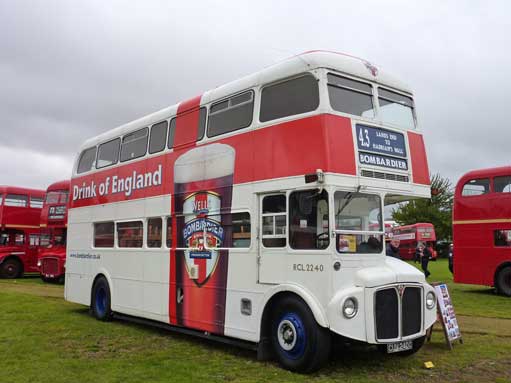 Bombardier, the ale producer, has taken a very patriotic all-over advert out on this Routemaster. Would such a livery have been applied by the vehicle's owner or at the request of Bombardier?
 The new Streetlite from Wrightbus was on display in a rather boring 'dealer white' livery
 The one on the left replaced the one on the right and now the one on the left is in the process of being replaced. Brighton & Hove brought an ex Go-Ahead London Mercedes-Benz Citaro along in its new provincial livery and was parked alongside a traditionally-liveried Routemaster
 No stranger to the LEYTR area is Ron Appleby, founder of Appleby's Coaches which, at its heyday, had depots on both sides of the Humber, with operations stretching from southern Lincolnshire to Scarborough. Ron's name was applied to the side of this 1974 Bedford SB5, new to his company
 There was a special line-up of Midland Red vehicles. Seen here is an ex BMMO C5, new in 1958
 Another Mercedes-Benz Citaro visiting was wearing a very striking overall pink livery for Manchester Airport-based Jet Parks. It was a most welcome sight amongst my photographs - standing out on what was such a dour day
 A damp guy
 Recently painted into EYMS's coaching livery is this Optare-bodied Mercedes-Benz O405, which wore Stagecoach stripes a number of years ago, though has never been owned nor operated by Stagecoach
 I've always been a fan of Lucketts' livery. It rather suits this Lahden body (with Scania chassis)
 The customary line-up of Routemasters was on display. A camera crew was filming here and only recently did I spot what it was for - a London-based edition of Inside Out in which the new Borismaster was reported on
 Another operator unfamiliar with LEYTR members is fellow member Fowler's Coaches of Holbeach Drove. Recently this operator has seen the merits of an apostrophe in its fleetname, for which we congratulate them. Here is their recently-repainted Leyland Tiger in front of their immaculate ex Lochs & Glenns tri-axle Volvo
 The Midland Red line-up in full
 Finally.... spot the deliberate mistake....


 I don't recall having seen this 1948 Leyland PS1/Willowbrook (1957) at a Lincoln running day before. The addition of 'Parcels Carried' where traditionally the registration is affixed was unusual, though those more au fait with Barton Transport will be able to say whether or not this was common place for bus 782 (WAL 728)
 Twice a year the Pyke Road cul-de-sac (opposite the Road Transport Museum) becomes a hotbed of PCV operation as it is from here were most services depart. Three main services are operated: to Lincoln City Centre (every 30 mins); a tour of Whisby (every 30 mins) and a service to the nearby Co-operative car park at the Moorland Centre, which acts as a park-and-ride (every 15 mins). Additional tour services are also operated at various timings. The morning and afternoon peaks are catered for with increases in frequency on the park-and-ride service, plus duplicated on all City services this year. It's nothing to witness up to 16 departures an hour leave here - rivalling that of Lincoln's City bus station.
 A mechanic's dream. Within the Road Transport Museum a whole host of displays are to be seen. Here in what m'colleague refers to as the 'mechanic's equivalent to a mini-bar' a very well-stocked presentation of what a mechanic's workshop from yesteryear would have looked like is displayed in a small corner. A list of 20 items have been listed and viewers are to look for them - from an Oxo tin to an emergency windscreen, they take some finding!
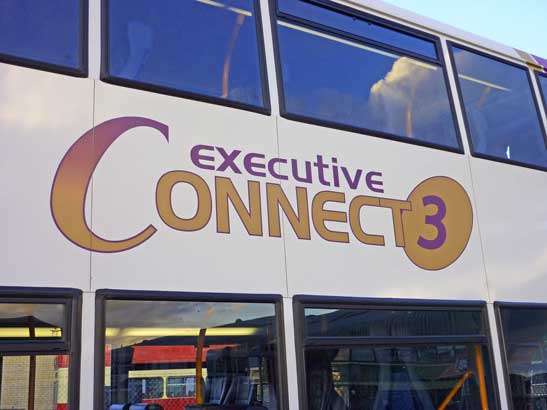 Not all vehicles visiting and operating services are in a preserved state. Stagecoach in Lincolnshire used the occasion to show-off one of it's new leather-seated Executive Connect-branded Scania/Enviro400s, used on the recently extended InterConnect 3 (Grimsby-Lincoln-Newark). The vehicle proved very popular indeed, which is most unusual at an event such as this. I vividly remember being the only one to opt to travel on Stagecoach's first Trident to enter service in London when, now in a preserved state, it provided a shuttle service at last spring's Cobham rally. Sadly, the Enviro400 is let down by its split lower windscreen
 Knowing the problems bus operators in Grimsby face with vandalism to seat backs, we were both very impressed at how presentable the rear seats were in the upper saloon. All six Scania/Enviro400s for the IC3 are now allocated to and operated by Lincoln depot, so that if they ever do stray it is on local Lincoln services. The seat backs are actually blue moquette, not leather, which is probably a sensible solution since the cost of repairing leatherette is considerably more expensive.
 Further evidence of congestion is seen here with a view from the turning area on Pyke Road. Seen here is Colchester 4 (OHK 432), a 1949 Daimler CVD6/Roberts (with a LEYTR member at the helm!) and Northampton VV 8934, a Daimler in the process of being restored. The view is from Stagecoach in Lincolnshire 15651 (FX10 AFK), the 2010 Scania/Enviro400 mentioned above
 Around 20 visiting vehicles were parked in a neighbouring site and from the North Bank was a regular supporter of local rallies, Hull Corporation 180 (GAT 180D), a 1966 Leyland Panther/Roe. Its chassis badge is in superb condition and worthy of a photo
 Also worthy of exposure is this Iveco 49.10 TurboDaily, new to West Yorkshire as their 191 (E446 TYG) in 1988 for operation in Keighley. Such vehicles epitomise the early years of bus deregulation for me. How matters have moved on to the situation in which we find ourselves today!
  They're England's second-oldest bus company and the last four of the six-generation Delaine-Smith family have been constantly engaged in bus operation. The company provided two vehicles from their trio of preserved 'deckers - Delaine 72 (ACT 540L), a 1973 Leyland Atlantean/Northern Counties can be seen in the distance and Delaine 50 (RCT 3), a 1960 Leyland Titan PD3/W.S. Yates has just passed the photographers. The latter exclusively features on this year's LEYTR front cover, posed at Delaine Close in Bourne. Both vehicles were working the 1500 service from Lincoln city centre to the Road Transport Museum, with 72 being 50's duplicate.
 Transdev Keighley's vibrant livery was partially hidden in the area where visiting vehicles were parked, owing to its close proximity to a wall. Despite this, we managed to take a shot anyway - and one not likely to have been captured by many attending. I assume this is the work of Best Impressions - the company who hates hyphens ('stress free')
