Once again, a friend and I decided to head into Derbyshire this Easter Monday, making use of the normal daytime Monday service being operated by the trains and the special Sunday timetables being operated by the buses. Owing to the problem last year, where we missed a planned connection and ran so late (when TM Travel provided a 23-seat Optare Solo on what must surely have been recognised as a very busy Peak District-bound journey from Sheffield) that we missed Plan B, C and D's connections. This year I was determined to stay away from similar 'honeypot' bus journeys.
158777 arrives at Grantham
The day commenced in Grantham where our 0845 East Midlands Trains Class 158 arrived from Boston. Normally, this would have been the first departure of the day from Skegness, but with engineering work taking place between there and Boston, replacement buses deputised. The train was very lightly loaded indeed. 158777 worked the service and we arrived punctually in Nottingham at 0920, quite by chance being aboard the second-shortest journey between these two points of the day (35 minutes - only the 2005 beats this, taking 32 mins).
Similar to last year, we both purchased a Derbyshire Wayfarer ticket, offering unlimited travel on the entire county's bus and train network, plus extensions to/from neighbouring towns and cities. A special version of this rover ticket is available from Beeston and Nottingham, which comes at an increased price: £14.80, compared with £8.90 for the main version. Had I planned ahead, I considered pre-purchasing a scratch-off version of the Derbyshire Wayfarer and then simply buying a cheap return ticket for the journey from Nottingham to the first station in Derbyshire through which my train passed, but Langley Mill (the station in question for today's itinerary) only offers an Anytime Return fare of £6, which, when added to the standard Derbyshire Wayfarer fare of £8.90, is 10p more than the Nottingham/Beeston supplement.
Talking of the itinerary, it had been planned as follows:
Nottingham - Sheffield (Northern Rail) Sheffield - Edale (Northern Rail) Edale - Castleton (Hulleys Service 260) Castleton - Hathersage (First Service 272) Hathersage - New Mills Central (Northern Rail) New Mills - Buxton (Bowers Service 61) Buxton - Chesterfield (TM Travel Service 66) Chesterfield - Nottingham (East Midlands Trains)
And to be fair, everything went to plan.
We boarded the Northern Class 158 that was awaiting departure on Platform 1 at 1015 and headed north-west into Derbyshire. From memory, the ability to travel regularly aboard a direct service between Nottingham and Leeds is relatively new, with this Northern service only starting around 2 years ago. How many actually wanted Leeds is not known to me but as with the first train in from Grantham, the patronage was very sparse!
158907 awaits departure at Nottingham, bound for Leeds
We called additionally at Langley Mill, Alfreton, Chesterfield and Dronfield before arriving at Sheffield, as advertised, at 1115.
We had 59 minutes to kill before our next train at 1214 to Edale, so headed into the city centre to see what was open. Replacement tram services were being operated by Stagecoach in Sheffield (the addition of the word 'in' on its bus fleet has recently been made to the fleet name) and Supertram maintenance cars blocked the tram tracks where work was clearly being made near the Ponds Forge/Fitzalan Square stop. Back to Sheffield for our next train and Pacer142031 arrived with a Manchester crew and we departed from Platform 8 on time.
Our first Pacer of the day was 142031, seen here at Edale
I always enjoy passing through the Totley Tunnel - the second longest mainline tunnel in the UK (recently knocked off its perch by the Stratford-St. Pancras tunnel, through which HS1 passes). But the real joy for me is the change of scenery. You leave the industrial scenery of Sheffield and emerge a few minutes later in the heart of the Peak District National Park. Our train was a stopping service to Manchester, taking up to double the travelling time of the non-stop services provided by TransPennine Express and East Midlands Trains. We alighted at Edale, which is the station most off-the-beaten-track.
When Stagecoach in Chesterfield reduced the number of contracts it operated in the Peak District, one of the main beneficiaries was Hulleys, with Service 260 being one example
On a normal Monday, you'd probably don your walking boots and go discovering mountains, but with today being a bank holiday, Sunday timetables were in operation on the county's buses and a special Sunday-only service, operated by Hulleys of Baslow, runs between Edale and Castleton. Service 260 has been running for decades and offers a very picturesque view as the bus climbs out of the valley, passing through a gap in the mountains at Mam Tor - the mountain that closed the A625 Sheffield-Manchester road in 1979, following persistent land slides forcing authorities to cut their losses and abandon the route.
The only route into Castleton from the west is the minor road known as the Winnats Pass. Buses, coaches and any vehicle in excess of 7.5 tonnes are prohibited from this meandering route, however Service 260 has permission. The following video is of the Hulleys driver navigating his vehicle down the pass, towards Castleton.
A niggle about the deployment of an Optare Solo on this run is that there is no back window through which to gaze, and as we ascended out of the valley in which Edale sits, the view is spectacular but not visible. The route makes two diversions along its length - the first to the Blue John Cavern and the second to Speedwell Cavern. Only we boarded the vehicle at Edale Station on its 1310 departure and two more joined at Blue John Cavern, though they alighted at Speedwell Cavern. The return journey from Castleton at 1340 was better patronised, though I don't think many people paid, judging by the average age.
Winnats Pass from the bottom looking up from the inside of Hulleys' Optare Solo
I had considered making an immediate return trip aboard the 260, but my friend had never been along Bridge Street in Bradwell, so we waited for First South Yorkshire's Sheffield-bound Service 272, which both arrived and departed punctually. Alternate journeys leave the main A625 to the east of Hope at the tiny hamlet of Brough and head south to Bradwell, where a loop of the village centre is made - one section being along Bridge Street, and is about as narrow as it gets for a double-decker bus in the UK, as the video below shows:
Additionally, the driver then has to make an immediate left turn which is almost as tight as Bridge Street itself. Stagecoach East Midland used to operate Alexander PS-bodied Volvo B10Ms on this route a number of years ago, when they operated the evening service, and with the rear overhang those vehicles have, an Alexander ALX400-bodied Volvo B7TL would be child's play! Still, there's not much room for error.
We travelled back to Brough and then east along the A625 through Bamford to Hathersage, where we bailed out and headed back to the village train station. Having passed through Hathersage by both bus and train on countless occasions, I've never alighted nor boarded any mode of transport here.
Seen at Hathersage is First South Yorkshire's 52-reg Volvo B7TL/Alexander ALX400. It had done in excess of 400,000 miles
The station is to the south of the village and is a very pleasant walk. Curiously, we passed near to what must be unique in the UK - a museum devoted to cutlery.
Our train was the 1432 Northern service to Manchester Piccadilly, though we'd be alighting at New Mills Central, the last stop in Derbyshire (and the last stop where our Derbyshire Wayfarer would be valid). We retraced our steps up to Edale and then continued west through Chinley to New Mills.
The station name New Mills Central conjours up the image of a bustling station in the centre of a busy urban location. Indeed, the fact 'Central' is needed at all implies other stations can be found in this heaving metropolis. Sadly, the small town of New Mills is nothing of the sort, although it does boast a second station and a total of three railway lines! New Mills Newtown is found on the southern side of the Goyt Valley, which the town straddles, and offers trains to either Manchester or Buxton. Pre-Beeching, it was the Midland Main Line linking London with Manchester via Monsal Dale and Bakewell.
Our second Pacer of the day was 142047, seen here at New Mills Central
New Mills on a bank holiday is about as sleepy as it gets. That said, I very much enjoy travelling through here. Subliminally, many a Derbyshire Wayfarer itinerary has seen me pass through. Although not a million miles from Holmfirth, the town has a very strong Last of the Summer Wine feel to it and epitomises a northern town that was deeply immersed in the Industrial Revolution, with cotton being produced here until as late as just a decade ago.
We had just over 20 minutes here before we were to depart, heading south aboard our second Optare Solo of the day, operated by Chapel-en-le-Frith-based Bowers. It was working Service 61 (Glossop-New Mills-Buxton), that offers an alternate route into its southern terminus via the much-less populated Fernilee, rather than the congested A6 trunk road. The views are excellent as the A5004 weaves around the mountain edges that board the Goyt Valley, before dropping down into Buxton.
375 (YJ54 UBH) was the Optare Solo provided for Bowers on our Service 61 journey and is seen here in Buxton Market Place preparing to leave for the journey north to Glossop
The last time we visited Buxton we headed to the water fountain in the town centre, opposite the famous Baths, to fill up a small 500ml water bottle with some infamous Buxton water. Then, we had to interrupt a lady that was filling enough bottles to keep your local branch of Tesco in business for a year. This time a chap was stood there filling up a water cooler bottle (about 18 litres), though as with the lady last year, was more than willing to stop for people who weren't taking the mick!
Buxton was actually very busy indeed, despite most of the shops closing at this time. We managed to make some strategic purchases in Waitrose before catching what was to be our last bus of the day back to Chesterfield - TM Travel Service 66, worked by 1156 (LA02 WMZ), an Optare M920/Optare Solo, new to Nostalgiabus of Mitcham in 2002. A total of five of us were on board as we headed along the A6 before turning off to pass through the very dramatic Millers Dale (only made so because of the double viaduct - over which the Blue Pullmanonce passed - and through Litton, Tideswell, Eyam and Stoney Middleton to what was our first bottleneck of the day - Baslow. It was only volume of traffic and nothing more serious, and once east of here, we headed unhindered into Chesterfield, arriving as advertised at 1738.
Chesterfield New Beetwell Street is the location for this shot - our last bus of the day
We made our way to the train station just in time to witness a raucous bunch of youths board a Sheffield-bound train (there'd been a football match) but witnessed some congestion for southbound services with our second bottlneck of the day unfolding before our very eyes. A Plymouth-bound CrossCountryVoyager occupied the new Platform 3 and a London-bound East Midlands TrainsMerdian was on Platform 2. The XC service hadn't moved in over an hour. It transpired a failed freight train was causing the problem and a number of northbound services had been cancelled as a result.
Everything wanting to travel in the Up direction was held at a red signal. This EMT service destined for London St. Pancras was but one!
Services didn't resume until about 1845, when the XC service left, though altered its destination to Birmingham, and those wanting to travel beyond had to disembark. A later XC service would operate to Plymouth and take those displaced passengers. A very flustered but unintentionally jovial female platform dispatcher earned her money during the melee, it had to be said. After the EMT service had gone, there was a steady stream of trains arriving: a second XC for Plymouth, a second EMT for London and one for Norwich, which we were going to board, but it was packed, so opted for a Northern service that would terminate at Nottingham and were right to do so as not only did it depart on time (1901), it was practically empty.
158906 arrives in a procession of trains. It's only travelling three stops, following a service that was already doing that, so we were right to await this Northern service as there was ample room
As we headed out of Derbyshire and into the neighbouring county, I looked at connection times for trains to Grantham and considered a quick trip on the Nottingham Express Transit (NET). Boasting one of the country's most modern tram networks, my travelling companion had never set foot on one of their Derby-built Bombardier units before. Our arrival in Nottingham was at 1938 and our EMT to Grantham would depart at 2051. Would there be time?
I'd not got a NET timetable with me and the Internet connection on my phone was not reliable enough to start downloading pdfs, so there would be nothing for it but a walk to the Station Street terminus (soon-to-be through station when Phase 2 opens). As luck should have it a tram arrived just as we did and I was comforted to see it was travelling to Phoenix Park - the shortest distance terminus on offer. Perhaps a return trip would be possible?
Timetable information for the NET has always been formidable. I have (I believe) every single version of the NET network timetable ever produced, with the current edition not having been updated since I last visited. Real attention to detail has always been made when designing the to-scale map, produced in such detail that it opens out to about five times the width of the timetable itself. Similar to the Supertram timetable produced by SYPTE in Sheffield, the main body of the timetable reads like that for a bus and I could soon spot (by picking up a timetable from inside the tram) that a trip to Phoenix Park and back would take just under 1 hour.
The Phoenix Park terminus is very convenient for people using the M1 Motorway and has a very large, free car park for tram users
There are a plethora of ticket options for travellers in Nottingham to make use of and the NET timetable (actually more of a tram guide) details them all. We needed to purchase a Day Ticket, costing oh-so-annoyingly a shade less than the cost of two singles, at £3. For an extra 20p users could avail themselves of the city's council-owned bus services, too. Exceptional value.
Easter Monday evening in Nottingham was pretty quiet and the tram didn't get very busy at all. This is just as well as the interior design of these trams is quite possibly the worst in the UK. I've ridden all the networks and my favourite is the Midland Metro,followed closely by Supertram. Sadly the NET design is cramped with very few 2+2. Even the 1+2 are uncomfortable as the floor raises to the outer shell of the saloon at a 45-degree angle, meaning one leg sits a lot higher than the other. They do look very sleek and cosmopolitan from the outside, though - not dissimilar in appearance to those running around Nice. Our tram was 208, named Dinah Minton.
Seen in fading daylight at the Station Street terminus is tram 208. The tram fleet numbering continues from the numbers given to the city's first generation trams
Having ensured my friend had managed to 'tick another transport-related box', we were back at Station Street and went down the stairs to the main station below. Engineering work on the Skegness Branch (as detailed in recent LEYTR Magazines) meant that trains were terminating at Boston. Our 2051 East Midlands Trains service was Skegness-bound (others to Grantham continue to Norwich) and we had a very pleasant ride to Margaret Thatcher's place of birth in an almost-desserted Class 158, which called at a few more stops than the one this morning, and we arrived into Grantham's bay platform (3) punctually at 2132.
Nottingham's bay Platform 2 is often where Skegness-bound departures leave from. Owing to a Network Rail possession east of Boston, this is where 158773 would termiate this evening. The East Midlands Trains livery - irrespective of the train type it was applied to - was in outstanding condition today.
Another excellent day's travelling both to/from Derbyshire and within it. Derbyshire continues to lead the UK in their public transport provision, from the production of high-quality and detailed publications, to bus stop timetable information and subsidised services on Sundays and public holidays. Their management of the Derbyshire Wayfarer should not go without praise, too. Excluding the PTEs, there aren't many counties that offer a ticket that is valid on any bus or train. True integration and competatively priced. And of course this is nothing new, for the Derbyshire Wayfarer has been available since the end of 1984.
M'colleague and I both attended the Easter Sunday running day, based at the Road Transport Museum in the Lincoln suburb of Whisby. It is arranged twice-yearly by the Lincolnshire Vintage Vehicle Society (LVVS) - an organisation that the LEYTR is happy to support!
I attended the last running day at the end of the season, which generally takes place on the first Sunday of November. This latter running day is usually the busier of the two owing the Easter Sunday having a number of other events taking place regionally and with the exceptional weather of late, a mass exodus to the Lincolnshire Coast features more prominently to families than attending a running day.
That said, a good attendance was in order as I arrived at the Moorland Centre, from where a park-and-ride shuttle service is operated to/from the Museum. The frequency was similar to that offered last November, with buses departing every 15 minutes and increased to one every 7/8 minutes between 1525-1702.
They're not everyone's cup of tea, but I grew up with RoadCar's Bristol VRs operating locally and vividly remember travelling many times between Louth and Grimsby
M'colleague headed in from the city centre, aboard the 1300 duplicate service, worked by Lincolnshire1056 (XFW 951S), a Bristol LH/ECW, which had to rescue passengers from a stricken Leyland Lion (KW 474) en route. Departures from the city centre were at 15-minute intervals.
At the Road Transport Museum the 'operational' vehicles were housed as ever in the usual compounds at the end of Pyke Road, which itself doubles up as a make-shift bus station. Within the Museum trade stalls and a mini canteen, staffed by volunteers, were in situ, along with vehicles under restoration being displayed at the rear extension to the main building - it was interesting to see how work has progressed over the winter. But what was of most interest to us both was a particular vehicle parked in the adjacent yard with the visiting vehicles:
Richard Belton's restored Lincolnshire 1904 (JVL 619H), a mkI Bristol VR which was withdrawn from the Lincolnshire fleet in the early-80s and purchased by a community group in Milton Keynes who adapted it for children to play in - which included a slide that enabled children to jump out the upper deck!
It has taken a lot of work and while being roadworthy, is currently unable to carry passengers. However, as Richard's work was done 'off radar' it came as quite a shock to many and was one of the most photographed vehicles of the day. Richard is also the LEYTR Treasurer and we've been fortunate over the years to visit the bus and witness the restoration work that has slowly been taking place (and will have a full feature in a LEYTR magazine later in the year).
Where m'colleague and I would just get a man in, Richard is fortunate enough to be able to turn his hand to anything and has ostensibly undertaken all the restoration work himself.
In the current LEYTR magazine, we featured a colour centre spread of the Bristol RE operating in various guises and liveries in Lincolnshire, and so it was only right and proper that we sample one today - which just so happened to be of the batch that featured in the centre spread: Lincolnshire 1431 (CVL 850D), in its original inverted green-and-cream livery, for use on express coach services.
M'colleague commented that the last time he'd ridden on this vehicle was in 1978 when it was based at Skegness. Back then, and for much of its formative years, it carried the all-over white NationalExpress livery.
After a very sedate and comfortable meander through the leafy lanes of Lincolnshire, we both headed into Lincoln city centre aboard a vehicle that is fast approaching its 51st birthday, Lincolnshire Lodekka 2378 (OVL 473), new on 1 July 1960.
Heading into Lincoln we passed the site of the former St. Mark's railway station and having featured a colour centre-spread of this now long-forgotten station (to mark the 25th anniversary of its closure) in the last LEYTR magazine of 2010, I fancied a wander back to the site and to meander through what currently stands in its place and to have a good old moan about Dr. Beeching.
This we did and here I deferred to m'colleague's encyclopedic knowledge about the station. Large sections of the east side are visible or in situ, tastefully incorporated into the retail development (Lincoln has *two* Primark stores, as any female will tell you!) with Argos respectfully displaying four very large black-and-white photos in its main entrance of the station both immediately prior to and during its closure and dismantlement.
The main entrance to St. Mark's is still in situ and has been lovingly restored
Original chimneys can still be seen from High Street. These are located immediately behind the restored main entrance (to Argos)
The signal box for the level crossing that crossed Lincoln's High Street is unaltered from 1985 and today houses a fast-food takeaway
Cleverly, the western side of the St. Mark's retail park has two coves that almost certainly represent where the railway lines once stood
And the signage for the retail park pays homage to the railway
The site office has been made to look like a signal box and bears what appears to be an authentic sign
This fencing depicts level crossing gates and ensures the unsightly deliveries yard cannot be seen
Finally, small reminders of the railway can be seen to the west with bridges built to carry the main line and sidings now used for road traffic and pedestrians. West of here the university and the Tritton Retail Park has completely obliterated any sign of the railway
We mentioned the new kid on the block in yesterday's post and plan to detail the new fortnightly publication in more depth now.
Issue 001 went live in March
Getting straight to the point, this is almost certainly the format New Transitshould have taken, rather than getting hung up on 'synergising' with everything and everyone. I would like to think that two years ago when we politiely criticised the 50% cut in Transit magazines when the new format was adopted, that some working in said publication also felt that perhaps they were not being forced in the right direction as Passenger Transport is produced and edited by the former Editor and Assistant Editor of New Transit!
Passenger Transport's managing editor and publisher is Robert Jack and his deputy is Andrew Garnett, both having left New Transit within what seemed like days of each other. Such a twin departure is very unusual and I'm sure there will be a story to tell!
However, every cloud and all that... has seen Messrs Jack and Garnett produce a publication that fills a most definite void in the market. Passenger Transport contains 32 pages and details transport news stories of the past fortnight. Specifically, in-depth balance sheet analysis is undertaken and reported, with the latest edition devoting two pages to National Express Group's 'bounce back' in a style identical to the old Transit. The omission of this information in New Transit was one of our main criticisms.
'exciting new journey' is a little cringeworthy, but we wish them both the best of luck. LEYTR subscriptions have not been hit by the financial downturn and if this is anything to go by, demand still appears high for a paper publication
Each Passenger Transport magazine (of which there have been four to date) omits a load of froth that can often consume the first few pages of some magazines (adverts and an extended contents page), and has a detailed story on its front cover; the editorial is on page 2 and then a lead story on 3 and another on both 4 and five. Pages 6, 8, 9, 10, 12 and 13 are devoted to transport news stories (16 in total) then 4 pages devoted to analysis - NEG and rail patronage growth following the release of latest figures. Alex Warner appears to have a regular two-page feature where he reviews rail journeys (this week Arriva Trains Wales, last week was Virgin). Two pages have been devoted to letters from readers (x3) followed by a fascinating two-page spread on Edinburgh's trams and how some may end up in Croydon.
Most industry publications seem to need to have a Westminster Insider and Passenger Transport is no different, though theirs writes the regular one-page Homer's Odyssey column, in which s/he imagines how the DfT's permanent secretary might be feeling right now, off-the-record of course. Towards the back now and 4 pages are devoted to events and event reports and one for careers. The back page is similar to most industry mags with tongue-in-cheek short reports (I do believe we featured in Issue 003, though they managed to re-word our trivia question so that it actually made sense!).
One would hope that with increased subscriptions will come the confidence to extend the news stories and analysis. Despite there always being room for more news stories in my mind, what there is appears to be of considerable substance. Photos are limited though in some cases appear very large, presumably to fill a page where text is limited.
Now to the price. I will admit to seeing the price tag and feeling a little disheartened, but I was comparing it with New Transit. There are double the number of editions of Passenger Transport a year than New Transit (possibly four times the number if New Transit start to double-up as they did with January/February), so the annual cost of £140 equates to £5.83 per copy (or £4.38 with a special offer that runs until the end of the month) is very favourable to the £7.92 that New Transit equates to.
Admittedly New Transit offers access to articles and archives online but (and I hope Passenger Transport appreciated this early on), not everyone wants to spend hours clicking away online - we like to be able to browse our magazine on the bus or Tube or in the queue for the temporary traffic lights that have been there for three weeks now and no work to show for it!
A special offer for 3 years' subscription is currently available, costing £281.25, which equates to £3.91 per copy. This is the same as Buses magazine but produced twice as often with more detailed and in-depth stories and analysis that very much appeals to us both.
In summary, if you felt New Transit headed in the wrong direction and that you want a detailed, informed transport magazine that doesn't make you gag by trying to offer synergies with everything, Passenger Transport is well worth a read. We hope others feel the same and are able to commit financially to this worthwhile publication. £281.25 might seem a lot, but we plan on dropping one of our subscriptions this year thereby saving just enough to splash out on Passenger Transport.
Our only criticism is that currently much of each magazine can be read for free online at the moment. We hope the plan is to limit this significantly in the near future.
New industry magazine Passenger Transport revealed that FirstGroup is no longer the UK's largest bus operator, being overtaken by Stagecoach.
Taken at Meadowhall during September 2009 is a vehicle now synonymous with First's UK bus fleet - a Wrightbus Eclipse Gemini-bodied Volvo B7TL
In its 2010 Annual Report, First stated that it operated 8,500 buses, but with the announcement just over a week ago that the company has placed a £160 million order for 955 new buses, has updated the number of vehicles in its employ, scaling down to 8,000.
By comparison, with Stagecoach acquiring the East London Bus Group from Australian bank Macquarie at the end of last year, an additional 1,300 buses were added to the company's nation-wide total of 8,100.
Passenger Transport claims that First operates 14% fewer buses today than it did in 2005, with the reduction in vehicles mainly taking place over the last six years, though with particular pace during the last eighteen months when the company chose to rather brutally cut mileage by a fixed 10% nationally, rather than trim gingerly and invest.
Seen at Cheddar Gorge during June 2005 is a Dennis Dart/Plaxton Pointer. At this time, First operated well in excess of 9,000 buses in the UK and that year heralded something of a watershed for the company's vehicle numbers
A further reduction to First's UK bus operation was announced today, when the company's East England division announced its intention to sell its King's Lynn network to rival operator Norfolk Green.
Of course, operating the most - or second-most - buses in the country matters not one jot. If anything, public perception of this can be a hindrance, with passengers believing that a bigger fleet means a bigger financial pot from which to draw and to operate more services. Sadly the privatised bus industry does not work like this!
Typically, a Stagecoach spokesman was quoted as saying: "We've never been fixated with being the biggest bus operator. Like our customers, we believe that offering the best value bus travel in Britain and providing a greener, smarter alternative to the car is more important."
Stagecoach is now the UK's largest bus operator and now opts for Alexander Dennis products, presumably because its founder and chief executive has a personal stake in the business. Seen here in Newcastle is a ADL Trident 2/ADL Enviro400
When it comes to trains however, Stagecoach operates the largest train operating company (SWT), but First's interests - one in partnership with Keolis - are considerably larger.
We mused last week about the likely savings large multi-national transport operators hope to make after they've got all their bus drivers using less fuel through more efficient driving. One way is being trialled by Stagecoach at a number of its UK bus depots - smart lights.
Lights that can detect when someone is in a room are nothing new. Just under a decade ago a friend used to work at a chicken factory in Scunthorpe and said his staff toilets employed this light-sensitive system. All was well provided you weren't someone who likes to take a paper in with you, otherwise expect to be plunged into darkness after 4 minutes.
Supplied by Contrac Lighting, the system being trialled at Ayr, Glasgow, Nuneaton, Leamington Spa, Gloucester and Chichester depots appears to be a little smarter than that at the 2 Sisters Factory. They can detect the amount of natural light and can dim or brighten to compensate. I really can't see how such a system can significantly reduce energy consumption, though Stagecoach reckon it will cut electricity bills by 40%, saving almost 230 tonnes of CO2 a year.
By 2014, Stagecoach hopes to reduce CO2 usage in its buildings by 8% and its fleet by 3%. The group estimates a combined CO2 saving of 40,000 tonnes by 2014, which will have a positive effect on its financial outgoings, too.
Of course energy saving is nothing new. In the 1990s BBC sitcom The Brittas Empire, leisure centre manager Gordon Brittas (Chris Barrie) instigated something similar to good effect, placing notices above light switches in all areas of the leisure centre with "This light switch is connected to the earth's dwindling resources". Who says council workers are unable to choose the cheapest option to reduce consumption!
It must be over a decade ago that I first spotted a designated Quiet Coach on a train. My father describes this and similar modern-day 'initiatives' as SOOT: Sign Of Our Times. I tend to agree with him here. It is a sad indictment of society that a carriage on board a train has to be designated 'quiet'. In many ways it confirms that public transport is no lesser subjected to the anti-social activities of a minority of travellers.
Noise is the problem - specifically too much of it. Time was when people would read or simply converse on a train journey. Then mobile phones came along en masse from the late-90s, so annoyingly loud one-way conversations could be heard (never better parodied that Dom Joly in his Trigger Happy TV programme). Today we have mobile phones that are (actually very good) music devices and can be connected wirelessly to the Internet in order to play movies and videos.
"HELLO!?.....YEAH, I'M ON A TRAIN...THE QUIET COACH..."
I recently made a journey with East Coast from Peterborough to Newark, for an article in a forthcoming LEYTR magazine. Unusually for me I purchased an on-the-day ticket (a Cheap Day Return) for travel betwixt both points. This meant I did not have a seat reservation so had to find one amongst all those that did have slips of paper above them. On my return from Newark I found most seats available in the Quiet Coach (Coach B).
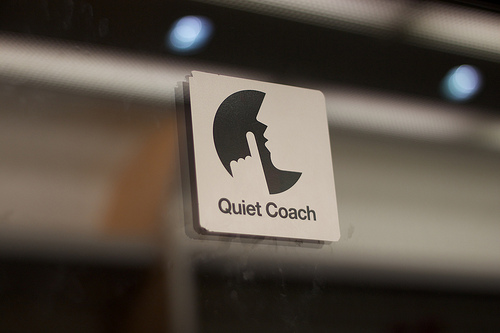
East Coast has displayed notices informing passengers that they are sat in the train's quiet coach and that phone calls need to be made in the vestibules at the carriage ends, that electronic equipment must be operated in silent mode and that conversations with fellow passengers must be kept as quiet as possible. You can't argue with any of that and if you did have a problem there are a number of other carriages you can opt to travel in.
However, Coach B of the 1818 Newark Northgate to Peterborough train yesterday, was not at all quiet. I heard rather graphic details of a conversation taking place two places behind me, where a man had been cheated on by his partner; a drunken Scots woman was making a phone call almost opposite me and a young girl in the seat in front was listening to music through headphones so loudly that I could hear the lyrics (Snoop Dogg, if anyone is interested).
East Coast affixes stickers like this to the window of its Quiet Coaches
My journey lasted but 29 minutes, so I wasn't unduly bothered, just very critical of the installation of a Quiet Coach when policing it is almost impossible. I'm sure guards are equipped with procedures in dealing with noisy people in these areas: a passenger can be asked to make a call in the vestibule but can everything else really be enforced? One person's idea of a loud conversation with the person sat next to him is not the same as another's. The girl in front of me had at least chosen to plug headphones into her iPod, whereas a growing number believe it is acceptable not to.
Specifically, had the events in Coach B occurred in any other section of the train in which I'd been travelling, I wouldn't have raised an eyebrow. As it was, the Quiet Coach actually made my journey less enjoyable. Operators who provide these sanctuaries of silence, I believe, are merely box-ticking. Enforcing their effectiveness is another matter.
The Working Time Directive (WTD) decrees that all workers are entitled to 5.6 weeks' paid holiday each and every year, with a pro-rata entitlement for part-time workers, based on their hours worked. This equates to 28 days per annum. How this is disseminated by each and every transport company up and down the land is not the concern of government and so this can range from firm to firm.
Most, however, opt to allocate their employees 20 days annual leave plus afford an additional 8 days for the recognised bank/public holidays. Pre-WTD, some operators allocated their workers 20 days holiday but this also included the 8 bank/public holidays so, in essence, these workers were receiving just 12 days they could use freely.
2011 will see nine bank/public holidays, with the Prime Minister announcing last month that the date of the Royal Wedding on Friday 29 April will be an additional holiday in the calendar.
However, the WTD has not been altered to reflect additional holidays that may be added to each Member State's calendar and consequently no employer need offer an employee the day off (or to work but with a day's holiday in lieu) when Will and Kate tie the knot.
CBW devoted a page in their latest magazine to answer specific questions concerning the legalities of not offering employees a ninth bank holiday when the Royal Wedding happens. There appear to be two things employees can do to see whether or not they are likely to receive an additional day's holiday:
Larger bus/coach/train operators will have negotiated with recognised trade unions and a decision will almost certainly have been made.
Smaller bus/coach operators who do not entertain a trade union in their workplace will unilaterally make the decision. Employees should check the wording in their contract of employment. Generally if wording indicates you are entitled to a specific number of holiday days PLUS bank and public holidays, then the likelihood is that you will have a case should a holiday not be granted, but if the contract states specifically eight bank/public holidays in addition to the number of annual days leave two which you are entitled OR that you have x number of days inclusive of all bank/public holidays, you may be on a sticky wicket if your employer chooses not to afford you the extra day.
Critchleys HR and Payroll LLP, who wrote the CBW piece, detail a section on staff morale. With the Royal Wedding costing an estimated £2.9 billion in lost earnings, a TV in the place of work so that the wedding can be viewed while people work, or an event of the company's own to celebrate the occasion, are suggested halfway houses. This clearly won't work in the transport industry at all.
The PM had to offer a bank holiday when the Royal Wedding took place - to not do so would be an affront to the Establishment (whether you're a royalist or not!). It is just a pity that, as is so often the case, well-meaning gestures are not bound by law and permit those companies who want to, the right to save a few quid at the expense of their employees.
 158777 arrives at Grantham
 158907 awaits departure at Nottingham, bound for Leeds
 Our first Pacer of the day was 142031, seen here at Edale
 When Stagecoach in Chesterfield reduced the number of contracts it operated in the Peak District, one of the main beneficiaries was Hulleys, with Service 260 being one example
 Winnats Pass from the bottom looking up from the inside of Hulleys' Optare Solo
 Seen at Hathersage is First South Yorkshire's 52-reg Volvo B7TL/Alexander ALX400. It had done in excess of 400,000 miles
 Our second Pacer of the day was 142047, seen here at New Mills Central
 375 (YJ54 UBH) was the Optare Solo provided for Bowers on our Service 61 journey and is seen here in Buxton Market Place preparing to leave for the journey north to Glossop
 Chesterfield New Beetwell Street is the location for this shot - our last bus of the day
 Everything wanting to travel in the Up direction was held at a red signal. This EMT service destined for London St. Pancras was but one!
 158906 arrives in a procession of trains. It's only travelling three stops, following a service that was already doing that, so we were right to await this Northern service as there was ample room
 The Phoenix Park terminus is very convenient for people using the M1 Motorway and has a very large, free car park for tram users
 Seen in fading daylight at the Station Street terminus is tram 208. The tram fleet numbering continues from the numbers given to the city's first generation trams
 Nottingham's bay Platform 2 is often where Skegness-bound departures leave from. Owing to a Network Rail possession east of Boston, this is where 158773 would termiate this evening. The East Midlands Trains livery - irrespective of the train type it was applied to - was in outstanding condition today.
 They're not everyone's cup of tea, but I grew up with RoadCar's Bristol VRs operating locally and vividly remember travelling many times between Louth and Grimsby


 The main entrance to St. Mark's is still in situ and has been lovingly restored
 Original chimneys can still be seen from High Street. These are located immediately behind the restored main entrance (to Argos)
 The signal box for the level crossing that crossed Lincoln's High Street is unaltered from 1985 and today houses a fast-food takeaway
 Cleverly, the western side of the St. Mark's retail park has two coves that almost certainly represent where the railway lines once stood
 And the signage for the retail park pays homage to the railway
 The site office has been made to look like a signal box and bears what appears to be an authentic sign
 This fencing depicts level crossing gates and ensures the unsightly deliveries yard cannot be seen
 Finally, small reminders of the railway can be seen to the west with bridges built to carry the main line and sidings now used for road traffic and pedestrians. West of here the university and the Tritton Retail Park has completely obliterated any sign of the railway
 Issue 001 went live in March
 'exciting new journey' is a little cringeworthy, but we wish them both the best of luck. LEYTR subscriptions have not been hit by the financial downturn and if this is anything to go by, demand still appears high for a paper publication
 Taken at Meadowhall during September 2009 is a vehicle now synonymous with First's UK bus fleet - a Wrightbus Eclipse Gemini-bodied Volvo B7TL
 Seen at Cheddar Gorge during June 2005 is a Dennis Dart/Plaxton Pointer. At this time, First operated well in excess of 9,000 buses in the UK and that year heralded something of a watershed for the company's vehicle numbers
 Stagecoach is now the UK's largest bus operator and now opts for Alexander Dennis products, presumably because its founder and chief executive has a personal stake in the business. Seen here in Newcastle is a ADL Trident 2/ADL Enviro400
 "HELLO!?.....YEAH, I'M ON A TRAIN...THE QUIET COACH..."
 East Coast affixes stickers like this to the window of its Quiet Coaches
 The Working Time Directive (WTD) decrees that all workers are entitled to 5.6 weeks' paid holiday each and every year, with a pro-rata entitlement for part-time workers, based on their hours worked. This equates to 28 days per annum. How this is disseminated by each and every transport company up and down the land is not the concern of government and so this can range from firm to firm.