30 December 2010

Who was William Huskisson MP?

I'll confess to not knowing this individual, though his dubious claim to fame is pretty significant. For William Huskisson MP was the first person to be killed by a train in the UK. Not only that, his death was to occur while a passenger on board the very first train from Liverpool to Manchester, operating along the UK's very first railway, on 15 September 1830.

Not only this, his death was the result of his spontaneous attempt to speak with the country's prime minister, The Duke of Wellington, who was travelling on the same train.

Hauled by steam engine Northumbrian - which was being driven by none other than George Stephenson himself - the MP for Liverpool had recently been removed from office and legend has it that Huskisson's attempts to make amends with the PM saw him approach his carriage when the train took on water at Parkside station. In a scene not dissimilar with that which exists in many developing countries today, passengers simply exited onto the tracks and were milling around during the interlude.

The Northumbrian engine

Huskisson climbed the exterior of the PM's carriage in an attempt to patch up relations when the infamous Rocket steam engine was heard in the distance, approaching Northumbrian and its rake of carriages at speed. Most of the milling passengers either returned to their respective carriage or moved to the other side of the train but Huskisson remained clung to the exterior of the prime minister's carriage, which was the side of the train that Rocket would be passing.
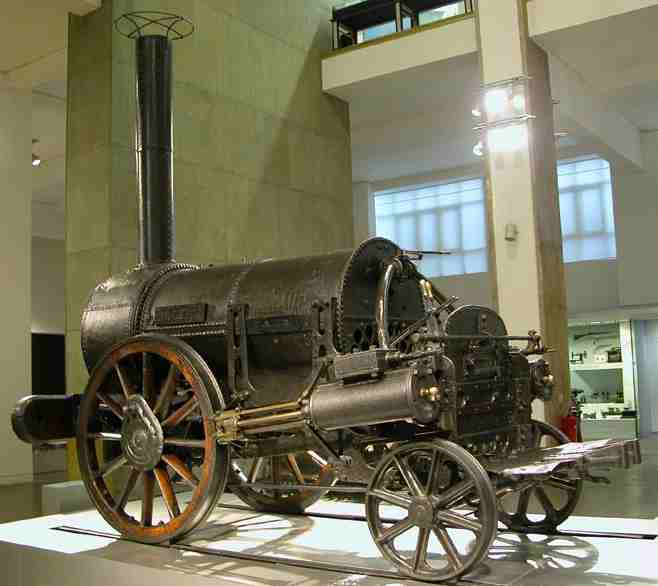
Steaming ahead, Stephenson's Rocket, which was indirectly responsible for Huskisson's death

It is understood that had Huskisson done as his travelling companion had asked ("For God's sake, Mr Huskisson, be firm!") he would have survived, but he clung so tightly to the carriage door that he managed to pull it open, straight into the path of Rocket, which dragged him from the door and under its wheels.

His still conscious body was removed from the track and placed on board Northumbrian which continued towards Manchester on its inaugural journey, with the MP for Liverpool taken off at Eccles and transported to the local vicarage where he was attended to but pronounced dead at 9pm that evening.

The monument at the location where William Huskisson MP lost his life

A number of statues and monuments are known to exist, depicting William Huskisson. The most notable is in Pimlico Gardens, London where a descendant of Huskisson produced a statesman-like figure in a Roman toga; a second exists in Chichester cathedral. Liverpool has two - one in the Walker Art Gallery and the other in the St. James Cemetery. The most poignant is monument located near to the place where died, which is by the immediate fence to the lineside and easily missed if passing by train.


29 December 2010

Scottie becomes Greyhound

From 10 January, the Silver Choice overnight Glasgow-London coach service will become part of First's Greyhound operation with a makeover that will see First compete with National Express and Stagecoach's Megabus services for the overnight Anglo-Scottish express coach service market.

Glaswegian Greyhounds with MD Alex Warner

We knew such an expansion was on the cards for Greyhound, which acquired its own managing director with just two routes operating last September. The Silver Choice service was operated independantly until two years ago when the company based in East Kilbride allowed First Glasgow to acquire its service enabling it to concentrate on its core businesses which include wedding transport and corporate hire.

It's also the first time the Greyhound brand has been brought to Scotland - a country that is more suited to the long-distance, inter-city operation that Greyhound is traditionally renowned for in North America. Having its HQ in Aberdeen, it was surely only time before First got in on the action, too.

The Irizar PB-bodied Scania coaches used on English Greyhound services will not operate the Anglo-Scottish ones, which instead will use ex-National Express First Cymru Plaxton Paragon-bodied Volvo B12Ms (a step down in our view); Wi-Fi won't be available though a free newspaper will continue to be offered. First claims that responses from customer surveys state passengers are 'not that interested' in extra leg room or free Wi-Fi and would just prefer to get from A to B as quickly and cheaply as possible.

Hmmm. Well, for those wanting additional leg room for the 9-hour journey, National Express operate a number of Scania/Levante tri-axle coaches with room to stretch out that are a marked improvement on First's Paragons. The choice is there, I suppose.


Taken from the LEYTR Top 'n' Tail jaunt of last year: compare the two photos above. On the left is the leg room afforded a traveller who is 5'-10" aboard a Plaxton Paragon-bodied Volvo B12M owned and operated by First and the right is what is afforded the exact same traveller on a tri-axle Scania/Levante operating on Anglo-Scottish services for National Express

Coaches depart Glasgow at 2200 and arrive London Victoria at 0700 calling only once at Hamilton. Northbound coaches depart London Victoria at 2200 and call only at Hamilton, arriving in Glasgow at 0630. Fares, similar with the competition, start at £1, though a booking fee is charged. Only National Express offer £1 fares with no booking fee for those able to print out their ticket at home.


28 December 2010

When buses know best

The future of the UK's largest municipal bus operator was confirmed just before Christmas, when councillors in Edinburgh wholeheartedly placed their support for Lothian Buses to remain independent for the foreseeable future. This has thwarted plans to merge Lothian Buses with the city council's tram company, TIE - the combined company would have been named Transport Edinburgh.

Councillors also backed plans to transfer the entire Edinburgh tram project to be managed by their bus company, subject to approval contained in a review that has been commissioned in a year-long review being undertaken at the moment.

The mock-up that was displayed in Princes Street last year bares the same livery as Lothain Buses so perhaps the transition of power won't be as difficult as councillors think for the public to comprehend

The merger would be the first of its kind in the country, with a bus company having the defining say on the construction of the beleaguered tram network for Edinburgh, not just the operation of the system when complete. Bus companies are no strangers to operating tram systems - or, indeed train companies - with First operating the Croydon Tramlink for TfL; Stagecoach operates Manchester's Metrolink and Sheffield's Supertram, both concessions for their respective Integrated Transport Authorities; Blackpool Transport operates its in-house network at the coastal resort; Nottingham Express Transit is headed by the city's bus company, NCT, in which French transport company Transdev has a 17% stake and National Express manages the Midland Metro on behalf of the West Midlands PTE.

Omitting Blackpool's first-generation system from the equation, no other bus company named above had the sole responsibility for the direction of the second-generation tram system it currently operates. Nottingham City Transport played a significant role in the direction of the NET scheme but nothing on par with that Lothian Buses could have if approval is granted.


But the euphoria ends there. The Edinburgh tram project is in serious trouble - something even the most optimistic of observers would have to admit. Not only is money in short supply but the political will appears to have all but gone, too. Not even the first phase of the scheme, linking Edinburgh Airport with Newhaven is likely to go ahead in full now, and this despite councillors desperately attempting its revival. What was described in the latest CBW as a 'vital' section between the the waterfront and the city centre may not go ahead due to a lack of funds.

If Lothian Buses is given the task of delivering and then operating the Edinburgh tram system in full, the 'road' ahead is to be very rocky indeed. It may turn out to be a poisoned chalice if not handled properly. Those at the top of the city's owned bus company may well be feeling the pressure right now. You can be rest assured that blame for any shortfall will be placed on the bus company, rather than the local authority.

A very rare shot of a quiet Princes Street in Edinburgh city centre. The street had just opened after having been closed to all traffic during the busiest months of the tourist calendar during 2009 while tram lines were laid down

We would suggest Lothian Buses effectively heads back to the drawing board with the scheme, where possible, and re-evaluates what is genuinely likely to be achieved. An updated plan that is genuinely manageable with the funding allowed, even if a shadow of the scheme's former self, will ensure success to be more likely and rewarding and provide a sound base from where extensions to the network could be taken seriously in the future. We would not like to see the company's failure to turn the system around to be seen as a green light for the city council to sell it off!

Edinburgh Trams
Lothian Buses


27 December 2010

Overturns & Seatbelts

Never before have we seen so many unfortunate incidents of coaches overturning on our roads. Two weekends ago yet another Oxford Tube Van Hool Astromega double-deck coach overturned as it existed the M40 at J7 and three days ago a Galloway European 60-reg coach, fully laden with elderly passengers, ended up sideways on the tarmac.

There was also an incident of a Megabus coach being involved in a serious incident near Bristol just hours after the Oxford Tube incident. More high-profile cases of recent years have involved National Express coaches, where people have died. Mercifully there have been no fatalities in the above two recent events.

What can you say about these recent overturns that hasn't already been speculated online or in print? Not a lot really. The Police investigations are ongoing and we're both confident that they will find the root cause of both accidents - as was the case with the two NX overturns. The fact that every single incident of a coach overturning over the past five years has involved a vehicle that is, at most, 4 years old is both surprising and alarming. Do the newer vehicles, despite passing their mandatory 'tilt tests', not handle as well as their older counterparts? Or does driver complacency come into play with the manner in which coaches can be driven nowadays being relatively effortless?

Another feature of every overturned coach incident of the past half-decade has been that seatbelts have been fitted throughout. The deaths in the M25/M40 overturn, that saw a double-deck Neoplan Skyliner leave the road as a result of the driver's negligence, were those who were not wearing seatbelts. In fact, many aboard the National Express 592 coach to Aberdeen were not wearing seatbelts and yet NX's work in ensuring its legal obligations to both provide and instruct passengers to wear them were not only being met but considerably improved upon. Drivers, for example, have been told for many years now to inform passengers of their legal obligation to wear a seatbelt. Award-winning information cards exist that state in clear, plain English the legal requirement for belts to be worn. Minimum legislation is for this sign to be displayed per every 2 seats and also at the front of each saloon:


Take the recent Galloway coach overturn. Around 50 people are reported to have been on board and yet there were only a handful of hospital admissions and no fatalities. The coach is understood to have been giving a tour of the Norwich area to a large number of OAPs who are naturally going to be very vulnerable in incidents like this, yet no one died. Sky News reported that Police were putting this down to two things:
  1. The coach, when overturning, landed on its side but did not travel very far at all on the tarmac, so the windows were not ripped from their frames and shards of glass embedded in the passengers
  2. That "most" passengers "appeared" to have been wearing seatbelts
Perhaps it's not seen as the 'done thing' by younger people today, but a seatbelt can genuinely save your life, even if the belt appears flimsy and unsubstantial. A three-point belt is going to naturally offer greater protection than a lap belt, but even that will substantially increase your chances of survival than wearing nothing.

Coaches appear very substantial vehicles to many passengers who may feel naturally safe when on board and thus lessen the need for wearing a seatbelt. Passengers may liken travelling by coach to that of a train, which do not feature seatbelts despite travelling at faster speeds, so choose not to wear one. They may also be aware of the fact that coach travel is the safest form of transport on which you can travel in the UK today and so complacency may creep in.

If nothing else, we both hope that the recent incidents will instill a little common sense into coach travellers who habitually choose to disregard the driver's instructions to wear a seatbelt.


26 December 2010

Merry Christmas

The Editors of the Lincolnshire & East Yorkshire Transport Review would like to wish all our members and blog readers a very merry Christmas and a prosperous new year. We would also like to thank the many contributors who have supplied us with subject matters to cover and unoffical 'takes' on stories that we may not be too averse with. A special thanks to The LEYTR Stig, who unlike Top Gear's, has not been unmasked.

A number of emails have been received asking why December was so thin on the ground with blog entries. We hope to resume normal service very soon indeed.

19 December 2010

Via

The more eagle-eyed blog readers may have noticed that the electronic destinations used to state the ultimate destination of coach services operating for National Express have recently been altered to include at least one calling point. "440 London", for example, is no longer accepted. A calling point needs adding "440 London via Leicester" seems to be the norm.

It would appear that National Express made a conscious decision to ask all its third party contractors operating approved coaches with electronic destination equipment to thusly modify their displays at the start of November. Words in capitals have now been outlawed, as had been the case with destination displays of all media for a number of years as a result of DiPTAC legislation. Scrolling displays, which are sure to only confuse those with a visual impairment more, are now accepted.

There are two distinct camps emerging: those who think this is a complete waste of time and that it serves to only complicate matters for the passengers and those who do not. Clearly are in the latter camp - it may even have been instigated as a result of passenger requests.

You may be forgiven for thinking NX's coach services are London-centric. While a sizeable proportion of the company's network radiates from the Captial, a look through the (now only downloadable) Coach Guide shows just how many services have nothing to do with London.

A large chunk of the network operates cross-country, for where an ultimate destination point is far more meaningless than 'London'. Last year, the LEYTR Top 'n' Tail jaunt saw us catch the former glory that was the 336 service, between Edinburgh and Penzance. Our Plaxton Paragon-bodied Volvo B12M operated by First Devon & Cornwall accordingly displayed "336 Penzance" though this was solely for our benefit as the first passengers for the Cornish town didn't board until Manchester Airport. We'd also estimate about 90% of those who boarded in total did not travel to Penzance either.

But with so many places being passed en route, where do you start when choosing a calling point to display? Admittedly the service now terminates at Plymouth, but what do you state? Glasgow? Manchester? Birmingham? Bristol? All four, scrolling beneath 'Penzance'? There are many other services that have a headache similar to this. Service 339 links Grimsby with Westward Ho! and calls at many places en route. Do you state via Lincoln? Lecicester? Birmingham? Bristol? Bideford? All five?

Do you state the largest - if so, Birmingham? But this would become meaningless for all passengers boarding after this point. This has now come to play on London-based routes heading north. Service 448 London-Grimsby now shows "448 Grimsby via Peterborough", yet Peterborough (the largest point served en route) is the first stop; thereafter a total 21 localities are served with a far more meaningless destination showing that had hitherto been the case.

Transport for London takes the exact opposite view to NX. They have reduced their calling points displayed to nil on most routes over the past few years, with the change generally taking place when new vehicles are entered into service. TfL said at the time that calling points become too confusing for tourists who will see "Piccadilly Circus" shown on a bus' display and board only to find they're travelling in the wrong direction. TfL's preferred option is for the ultimate point to be shown and nothing else.

Of course older coaches with the more traditional roller blind destinations are currently exempt from the latest ruling from Birmingham; they'll naturally become extinct with vehicle renewals.

Surely one way NX could have got round the confusion "336 Plymouth" causes passengers travelling between Carlisle-Stoke is to state on the passenger's ticket the ultimate destination of the coach they will be catching. Most train operators' websites have the function to look-up the complete list of calling points for the service in question - as does NX's own excellent coach division website. A simple extension to the ticketing where the service number is stated is all that is needed "Service: 336. Coach will display Plymouth on its destination screen."

As it is now, more wording is being crammed into a small space, making the font smaller than it had previously been - sure to only confuse passengers further. At the very least, services radiating from London should have been left alone, certainly London-bound. We believe there is no such thing as a one-solution-fits-all in this situation and that a partial re-think is needed.


13 December 2010

Tram driver jailed

It's no laughing matter but there are a couple of similarities between a recent news story from Blackpool and the latest in the world's longest soap opera, Coronation Street.

Viewers of the soap will be well aware of the events one week ago, which saw a two-car Bombardier M5000 tram in the new Manchester Metrolink colour scheme derail on the viaduct that passes the end of the nation's most iconic street, plunging onto the cobbles via a corner shop and the Kabin newsagent. Turn the clock back even further and a storyline took place in Blackpool itself where character Alan Bradley was killed by one of the town's iconic trams while in pursuit of Rita Sullivan (was her surname Sullivan then?).

Carnage on Coronation Street as a tram falls from the viaduct after an explosion from the club beneath

August 2009 saw something very similar happen in Blackpool, when one of the towns trams killed a 70-year old holidaymaker who was at the resort celebrating her wedding anniversary. The driver of the tram was sentenced to 15 months in prison at the end of last week, after pleading guilty to the charge of causing death by careless driving.

In Coronation Street, neither tram-related incident was the fault of its driver but the two storylines and the latest from Preston Crown Court have firmly put trams in the the minds of millions more people in this country over the past seven days then before. In Blackpool last year, 70-year old Maureen Foxwell was killed as she crossed the tracks immediately beyond a stop at which a number of people were awaiting the oncoming vehicle. She and her husband assumed the tram was slowing down to stop, but the driver - Paul Edensor - had other ideas. He chose not to stop for the intending passengers (his tram was 'in service') and killed Mrs Foxwell.


Edensor, who'd been disciplined before for speeding, was travelling more than three times over the permitted limit speed at the time (estimated 13-17mph in a 4mph section of track). During the trial it emerged that Edensor also had 12 previous convictions relating to 23 offences. Detail of what these convictions were and if they were related to his employment with Blackpool Transport were not made known.

LEYTR Comment: In many ways, driving a tram requires more concentration and faster response times to that of a heavy rail train or locomotive. On-street running is something train operators do not do. Cars, cycles, buses and pedestrians are all additional hazards to contend with while controlling a vehicle not dissimilar in both size and length to those which link Manchester with Leeds or run along the Cornish branch lines. Many tram drivers use their experience to gain promotion and become train drivers. A friend of mine did just that and found the job of becoming a train driver far easier than driving around the streets of Sheffield in a tram.

Of course the incidents highlighted above are, thankfully, not representative of the professionalism with which tram drivers carry out their duties. The
Blackpool Transport employee had a long line of offences against him and had previously been disciplined for speeding. Consequently a custodial sentence was to be expected. The light rail industry has no place for people like him. Compared with Coronation Street's portrayal of trams last week and in Blackpool many years ago, neither incident could be blamed on the tram nor its driver. We just hope others see this in the same light and that no ill effects are felt on tram patronage nationally.


12 December 2010

Rover Restriction

RailUK forum has detailed information affecting the All-lines Railrover (ALR) ticket, which offers either a week or a fortnight's unlimited, unrestricted travel on the entire national rail network. Sadly the news is not good (and has been mooted for a number of months now): a weekday morning time restriction.

An ALR will not be valid on Mondays-Fridays for boarding or alighting train services operated by CrossCountry, East Coast, East Midlands Trains and Virgin Trains before 10.00 Mondays – Fridays at Birmingham New Street, Bedford, London Euston, London Kings Cross, London St Pancras, Luton, Luton Airport Parkway, Milton Keynes Central, Stevenage and Watford Junction.

This is better than a blanket ban on the ALR's usage before 1000 on weekdays, but nonetheless problematic for many people for whom an ALR is actually cheaper than a season ticket and, of course, for the thousands of rail enthusiasts who purchase the ticket each and every year.

During the summer, rumours were abound that the Association of Train Operating Companies (ATOC) was to simply prevent holders of an ALR from travelling on any long-distance 'express' train operating company's service but this never materialised though with the latest news being made known, we suspect that a fairer imposition on the ultimate train ticket was being negotiated.

Myself and a LEYTR Associate, who's a train driver, had planned on a second LEYTR Railrover from next spring (read our first one here), though our rough itinerary has had to be drastically altered on a number of occasions to take into account the potential for this 'third way' restriction being introduced. And as with any 'third way' it's littered with holes. There is, for example, nothing to prevent a passenger from boarding at Birmingham International pre-1000 on a Tuesday. An ALR holder could board at Bedford heading south and claim he joined the train at East Midlands Parkway or Leicester.

And the question of why such a restriction is warranted needs to be asked. The restriction clearly depicts very busy interchanges where commuters are aplenty and the cost of travelling is incredibly high in relation to other times of the day. But are the numbers of ALRs really so high that users are preventing people whose annual season ticket costs £6k from a seat? The ticket is not officially advertised (we believe only Northern make reference to it in one of its publications) and so its popularity is at the Nadir of what it could be. It could be conceivable that the ALR might be the victim of its own success if there'd been a massive push to advertise it but the only person who did that was the then Transport Minister Lord Adonis. Barry Doe occasionally cites examples when an ALR is cheaper than a weekly season ticket between two points for those commuting sporadically, but other than that it is the industry's best-kept secret.

In the mean time we can but hope this is just a rumour floated by ATOC to see what opposition there is likely to be to the watered-down restriction.


01 December 2010

Punctual 'leaf fall'

Driving into work yesterday morning, I couldn't help but laugh along with Radio 2's DJ Richard Allinson, who found much amusement in train operating company Southern's excuse for delays in excess of what it would normally expect during the 'leaf fall' period.

Southern's press release claimed that leaves not only fell too fast but that they were of the wrong consistency when they landed on the tracks, giving a Teflon-type coating to the metals, which accordingly saw their punctuality nosedive from that reported during the same 'leaf fall' period of 2009.

I full understand the problems train operators and Network Rail face from leaf fall and am categorical that if you took a disheartened, unsympathetic Brighton-London commuter, sat him down and demonstrated the issues leaf mulch on the line causes in terms of reduce adhesion and circuitry problems in identifying a train's location, he/she would eventually be won over. Getting the same recent leaf-fall convert to then come to terms with what is effectively the "wrong type of leaf" would undo all your hard work.

It might technically be true and it might technically have accounted for the delays but it is not what people want to be told in a manner which appears to seek solely to justify the reduced punctuality of a train operator. It has echoes of British Rail's now infamous "wrong type of snow" press release that gave newspapers days of fun.

Taking a more cynical tack, the manner in which a train's punctuality is recorded requires wholesale alteration. If a long-distance service was checked at every station to ensure it departs within 9:59 (4:59 for local services) of its timetabled timing, rather than only the route's terminus being the only station that counts, the emphasis Southern et al place on a slight decline in their 'leaf fall' period's punctuality would be nothing compared to the hard work, in conjunction with Network Rail, required to ensure services are consistantly reliable and operate as per the advertised times.